Get Full Government Meeting Transcripts, Videos, & Alerts Forever!
Get email alerts on the Intervention Program Monitoring topic
No spam. Unsubscribe anytime.
BRN IEC discusses shorter timelines, tighter monitoring for mental-health-only participants
Summary
At its May 20 meeting the California Board of Registered Nursings Intervention Evaluation Committee discussed tailoring timelines for "mental-health-only" participants, expanding monitoring tools such as pharmacy audits and work-site monitors, and scheduled a follow-up discussion on "failure to derive benefit."
SACRAMENTO
At a May 20, 2026 meeting, the California Board of Registered Nursings Intervention Evaluation Committee (IEC) discussed training progress and possible changes to how the intervention program manages nurses with mental-health-only concerns, emphasizing competency-based release rather than a fixed three-year timeline.
"This one's going to be pretty short and sweet," Laura Melby told the committee as she reviewed completed training and proposed topics for future educational rounds, including "failure to derive benefit" and the use of clinical diagnostic evaluations. Melby asked for committee feedback on how to apply training in return-to-work determinations.
Why it matters: The committee evaluates whether nurses in the intervention program can safely resume clinical duties. Changes that permit shorter, competency-focused participation for mental-health-only cases could speed some nursesreturn to work while relying more heavily on monitoring tools to protect patients.
Melby said mental-health-only participants do not automatically require the programs three-year sobriety-based timeline. Instead, she said, the committee should assess whether a participants competency "is affected by their mental health" and tailor the period in the program accordingly. She described scenarios in which medication stabilization and supervised work-site monitoring could create confidence for an earlier release, noting a typical medication titration period of 12—16 weeks and suggesting that a six-month monitored period could be sufficient in some cases.
Committee member Laura Thomas praised a proposed tool in particular. "That's like a game changer as far as I'm concerned for those who have diverted," Thomas said about the option to mandate pharmacy audits, adding that forced review of Pixis or Omnicell reports and comparison of access and usage patterns could improve oversight.
Melby and members discussed a menu of monitoring strategies: mandated pharmacy audits, daily or shift video review where available, escorted or observed medication administration and wastage, work-site monitors who serve as "eyes and ears," and targeted follow-up calls by guest services or patient-relations staff for post-discharge checks. Melby said monitoring could be tightened ("lock it down") for higher-risk cases and loosened later if evidence supported it.
She also described remediation steps when knowledge or skill gaps are observed: targeted continuing-education units, refresher classes, supervised return-to-practice with progressively reduced observation, and, in some cases, retaking exams such as the NCLEX where appropriate.
Melby cautioned that the most extreme outcome remains possible when competency cannot be restored: "we do an 820 and we pull their license" for cases in which a participant is a danger to self or others, she said.
The committee agreed to take up the topic "failure to derive benefit" at its next session, asking staff to prepare materials that detail how long participants can remain in the program, what constitutes adequate monitoring evidence, and when license-revocation steps should be considered.
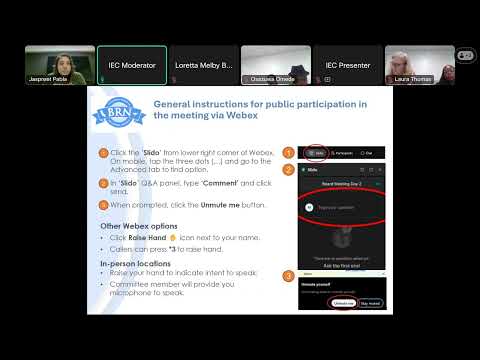
There were no public comments during the meeting.
Next steps: Staff and IEC members will prepare materials on failure to derive benefit for the committee's next meeting; the IECs next tentative meeting was scheduled for Wednesday, July 22, 2026.