Get Full Government Meeting Transcripts, Videos, & Alerts Forever!
Get email alerts on the Photo Documentation topic
No spam. Unsubscribe anytime.
SHPO webinar lays out photo documentation rules for historic tax credit applicants
Summary
The State Historic Preservation Office advised applicants to document entire properties (pre- and post-work), use clear photo keys tied to pre-renovation plans, preserve original image files, and expect reviewers to compare Part 1 and Part 3 photos when certifying projects.
The Office of Cultural Development(the State Historic Preservation Office) held a webinar explaining photographic requirements for historic tax credit applications, emphasizing that photographs are central to eligibility and certification. Emily van Doran, a tax credit reviewer, said, “photo documentation is an important part of the tax credit application process,” and walked attendees through what reviewers expect at each application stage.
Why it matters: reviewers use pre-renovation photos in Part 1 to confirm a building retains sufficient historic integrity and to judge whether proposed work will meet the Secretary of the Interior standards. Van Doran warned that “the part one photos must be taken before any work on the building begins,” and that lacking pre-work photos can delay or preclude an eligibility determination.
What applicants should do: photograph the entire exterior, interior, site and all buildings on the property, and create a photo key tied to the pre-renovation floor plan showing each photo location and arrowed direction. The presenters recommended numbering photos consecutively and matching the Part 3 (completed work) photo key to the Part 1 locations when reasonable so reviewers can readily compare before-and-after conditions.
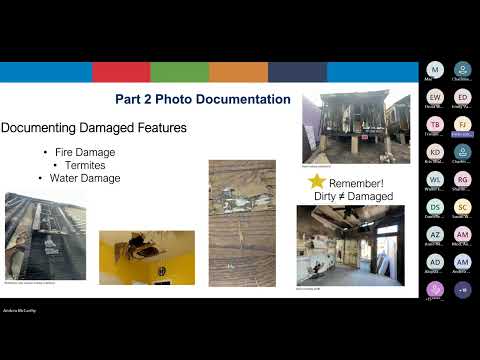
Damage and Part 2: applicants documenting damage (fire, termite, hurricane) should include wide-angle room views plus close-ups that clearly show the affected materials. The presenters said historical evidence (neighboring houses, aerial images, Google imagery) and photos taken during exploratory demolition can support proposals when original features are missing.
Digital submission and file-format guidance: the National Park Service requires color, high-resolution images; applicants should preserve original JPEG or TIFF files and avoid excessive compression when creating a PDF submission. The presenters noted that NPS currently allows up to 20 JPEG/TIFF images as an exception but advised keeping original files available in case reviewers request higher-resolution images.
Practical tips: begin photo sets with an elevation (head-on) image, follow with perspective shots, avoid camera tilt that causes convergence, favor side or front lighting for texture, and include detail shots of significant materials. The presenters also recommended supplying separate captions and a header on each PDF page with address, date and application part.
Next steps: the webinar recording and registration for the next session (on the Secretary of the Interior standards) are available on the SHPO website; attendees were invited to contact the office by email or phone with follow-up questions.