Get Full Government Meeting Transcripts, Videos, & Alerts Forever!
Get email alerts on the Land Use topic
No spam. Unsubscribe anytime.
Grant County subcommittee narrows draft data‑center rules, debates buffers, lighting and bonding
Summary
A volunteer subcommittee reviewing a draft Grant County data‑center ordinance advanced several tentative edits — including lower night lighting levels, solid screening with earth berms to reduce noise, a proposed 250‑ft buffer placeholder, a 5‑mile property‑value guarantee radius and a required 5A security bond — and heard extensive public concern about noise, water and property values.
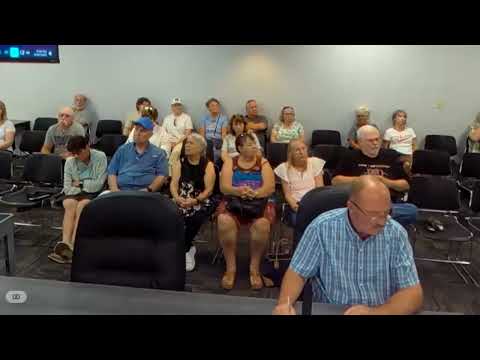
A Grant County volunteer subcommittee continued work on a draft data‑center ordinance on June 12, advancing several provisional changes to lighting, screening, buffer and financial‑assurance provisions while soliciting public input on noise, water use and property values.
Chair Randy Atkins opened the meeting by describing the panel as a recommending body to the Area Planning Commission and county commissioners. The subcommittee began review at the top of letter H (lighting, screening and site design) and agreed to refine specific standards rather than leave placeholders in the draft.
On lighting the group debated the commonly used 0.5 foot‑candle limit measured at the facility property line, with members asking whether the county can reliably measure that level and whether the standard should be lower. “A .5 foot candle is about five times brighter than a full moon,” a participant explained during discussion; several members proposed testing 0.25 foot‑candles as a starting point for the draft.
The panel moved into a sustained discussion of fencing, berms and sound mitigation for continuous rooftop cooling equipment. Members favored screening that combines an earth berm with a high fence and solid visual/acoustic barriers, citing concerns that an 18‑ft berm alone may not block noise from equipment 30–40 ft above grade. The committee noted prior internal targets aimed at residential nighttime sound levels in the 30–40 dB range but annotated the draft with “question marks” pending acoustic modeling.
Committee members debated buffer widths along public road frontage and around project perimeters. A placeholder 25‑ft buffer became the subject of extensive pushback; committee discussion moved the draft toward a substantially larger starting point (members discussed 100 ft, 200 ft and settled on 250 ft during deliberations as a negotiable figure to take to the wider APC).
On financial assurance, the subcommittee decided to limit acceptable instruments to a 5A security bond rather than a menu of letters of credit or escrow options, and to preserve a requirement that any security be sufficient to ensure installation and maintenance of screening plantings. The group also debated a developer‑funded pooled security to guarantee compensation for proven property‑value declines; members discussed a proposed funding target (a roughly 3% pool of aggregated assessed values was suggested in the draft) but asked staff for analysis rather than adopting a number by fiat.
The panel revised notification and pre‑application provisions. The draft was changed to require at least two pre‑application informational meetings in Grant County (hosted in public venues adequate for turnout), notification signage at the time of lease or purchase rather than waiting until permit application, and clearer sign legibility criteria and proofs to prevent token notices that are unreadable from public rights of way.
Throughout the evening, residents urged stronger protections. Dave Stanley, a Grant County resident, told the panel the proposed berms and plantings may not block noise from rooftop cooling equipment and flagged irrigation demands for landscape buffers. Rhonda Coleman said online videos show persistent lighting and argued the proposals could reduce property values. Multiple commenters expressed concern about water use and wastewater handling, and some urged closed‑loop cooling systems to limit groundwater withdrawals.
The subcommittee repeatedly emphasized limits to its jurisdiction: the panel can recommend standards for unincorporated Grant County but cannot impose them inside incorporated towns that control their own zoning. The members said the draft aims to preserve as many local protections as legally feasible and to give residents advance notice and a role in shaping county recommendations.
No formal ordinance was adopted; the subcommittee left multiple numeric standards (exact foot‑candle level, final buffer width, and the mechanics of the property‑value guarantee pool) for further analysis and for broader APC review. Members scheduled another meeting to continue work (the draft is roughly halfway through at page 16 of 37). The APC will consider any subcommittee recommendations in a future public hearing before forwarding to county commissioners.
The committee asked staff to return with technical research on acoustic measurements, realistic foot‑candle examples, plant species that establish more quickly, and legal analysis of bonding and property‑value guarantee mechanics.