Get Full Government Meeting Transcripts, Videos, & Alerts Forever!
Get email alerts on the People Initiative And Reform topic
No spam. Unsubscribe anytime.
Committee weighs legislative responses to property-tax initiative, including a 2% transfer tax and statute drafts
Summary
A legislative committee reviewed how the voter people's initiative would interact with existing homeowner exemptions, discussed a possible 2% real-estate transfer tax as an alternative revenue source, and voted to request multiple bill drafts and additional fiscal modeling from Department of Revenue staff.
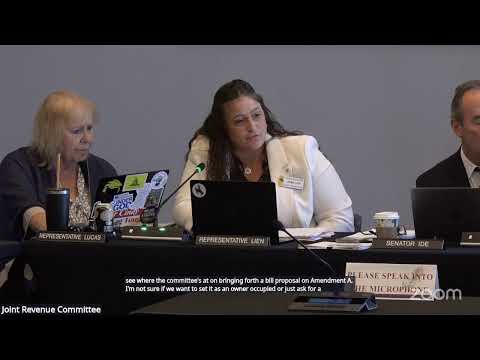
A legislative committee met to consider how a pending people's initiative on property-tax exemptions would interact with existing homeowner relief and to request draft legislation and revenue models.
Committee chair McHugh opened the afternoon session by saying the initiative's passage would raise several questions about interaction with last year's House Bill 45 and the existing 25% homeowner exemption, and that the committee would have clearer options after the November election when vote results are known. "If the initiative passes, I think it's clear how it interacts with the long-term homeowners exemption," McHugh said during opening remarks.
Why it matters: members repeatedly stressed that any citizen-initiated constitutional change has timing constraints that limit immediate repeal. Staff cited constitutional language (Article 3, section 52 as quoted in the meeting) that an initiative "cannot be repealed for 2 years" though it may be amended, which narrows legislative options in the short term.
The transfer-tax illustration: staff provided a quick worked example comparing annual property tax on a sample home to a one-time 2% real-estate transfer tax. "A $400,000 house at a 9½% assessment rate with an average statewide mill levy of 68 mills equals $2,584 in property tax per year," a staff analyst told the committee, "a $400,000 house at a 2% real estate transfer is $8,000. ... Three years would be three years of property tax would be close to say the real estate transfer tax." Committee members asked whether a transfer tax would apply to owner-occupied homes only or all residential transfers; staff said the estimate they discussed was based on all residential transfers.
Targeting and equity questions dominated the discussion: several members urged modeling that distinguishes short-term holders/speculators from long-term owners and suggested considering floors (for example, exempting transfers under $1 million or $2 million) so the tax focuses on higher-end/speculative transactions rather than ordinary homeowner moves.
Bill-draft directives and next steps: the committee approved motions to request multiple draft bills and further modeling from Revenue and LSO staff, including (a) a draft on fair-market value at time of transfer with an associated constitutional-change option, (b) a draft to resurrect prior repeal language on residential property taxes, and (c) a clarifying draft that would specify which existing relief programs would remain or be eliminated should the citizen initiative pass. Staff were asked to produce updated fiscal models (including comparisons to the 25% exemption, options that include land, and the distributional effects of a 2% transfer tax) ahead of the next meeting.
The committee emphasized that these are policy-development steps, not final actions. Several members noted the state must ultimately identify replacement revenue if local property tax sources are removed: "Nothing is free — it has to come from somewhere," one member said while others pointed to state investment earnings or diversified revenue options as alternatives to relying solely on mineral revenues.
The committee recessed after directing staff to prepare the requested drafts and updated fiscal analyses for the next meeting.