Get Full Government Meeting Transcripts, Videos, & Alerts Forever!
Get email alerts on the Budget topic
No spam. Unsubscribe anytime.
Greeley-Evans School District 6 previews $340.5 million general-fund budget, plans $8.2 million draw from reserves
Summary
District CFO presented a proposed 2026–27 budget showing $340,462,000 in general fund revenue, a modest per-pupil funding increase driven by recent state legislation, and a planned $8.2 million use of fund balance for one-time items including a $3 million health insurance transfer and $2.2 million in technology replacements.
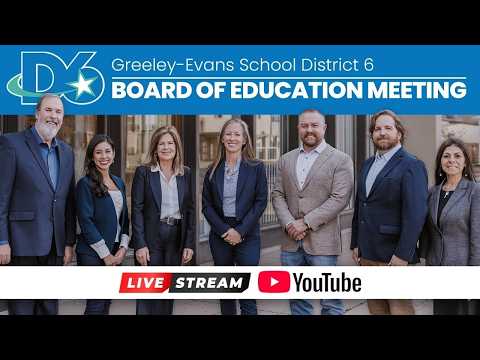
Greeley-Evans School District 6 finance officials on Tuesday walked the board through a proposed 2026–27 budget that projects $340,462,000 in general fund revenue and outlines an $8.2 million draw from reserves for primarily one-time needs.
CFO Megan Sponsor summarized the revenue picture, saying two pieces of state legislation — House Bill 241448 and Senate Bill 2623 — raised the base per-pupil funding by roughly $29 (about 2.4%) and phased in a new school finance formula at 30 percent. Combined, she said, that yields about a 3.5 percent increase in per-pupil funding. Across all funds the district projects roughly $440 million in revenue.
The district projects a slight decline in funded pupils: 79 fewer students overall, with 17,078 in non-charter schools and 5,024 in charter schools for a total of 22,102. Sponsor said this year is the first in which per-pupil funding will top $12,000. She also emphasized that about 84 percent of general fund spending is salaries and benefits.
Sponsor told the board the proposed $8.2 million draw from fund balance is intended for three main, largely one-time purposes: a $3 million transfer to shore up the district health insurance fund, roughly $3 million allocated to coops related to a new building or buildings, and $2.2 million for technology (replacement Chromebooks, staff devices and classroom equipment). She said the district has a “healthy reserve” but warned that repeatedly tapping reserves for ongoing expenses would be unsustainable.
Board members asked about the pace of enrollment change and whether the district had met with the demographer; Sponsor said staff has the demographer’s data but has not yet met to review long-range projections in detail.
Directors also questioned the district’s younger-student device strategy after the state moved certain assessments fully online this year. Sponsor said a statewide requirement eliminated the paper option this cycle, producing faster turnaround for results but also some dips in performance where students had not tested online before; she said kindergarten devices are generally kept in the classroom unless families request devices to go home.
Sponsor and board members said the district will present the proposed budget for final consideration at the upcoming business meeting. The work session provided board members time to ask detailed questions and to flag follow-up items about enrollment forecasting and long-term reserve planning.