Get Full Government Meeting Transcripts, Videos, & Alerts Forever!
Get email alerts on the Gaming Revenue Policy topic
No spam. Unsubscribe anytime.
Wyoming committee probes gaming revenues, auditors and seeks statute fixes for purses, breakage and problem-gambling funding
Summary
The Select Committee on Gaming reviewed how Wyoming taxes and audits Historic Horse Racing, simulcast, ADW, skill-based games and online sports wagering, heard industry testimony on race-day consolidation, and unanimously approved bill-draft requests on purse minimums, breakage allocation and broader problem-gambling funding.
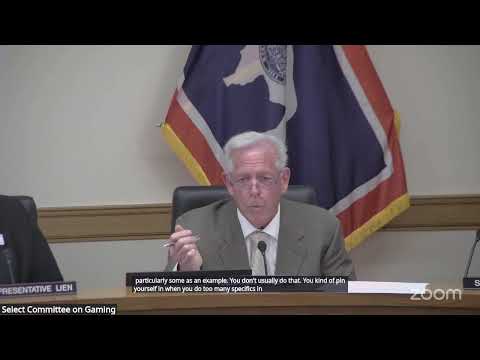
The Select Committee on Gaming heard a full briefing May 14 on how Wyoming collects, audits and distributes gaming revenue and approved a series of bill drafts to address purse guarantees, the handling of unclaimed “breakage” and broader problem-gambling funding.
Governor’s deputy policy director Sarah Dorenzo opened the meeting urging stronger, clearer protections and better use of problem-gambling funds, saying the governor wants regulations that “support this thriving economy and protect the wagering public.”
Nick Lair Mindy, executive director of the Wyoming Gaming Commission, described how Historic Horse Racing (HHR) is taxed and audited. He told the committee HHR is taxed on total handle and that the 1.9% total HHR tax is split into a breeders award (0.4%), the state/commission (0.25%), the Livestock & Supplemental Revenue account (0.25%) and a 1% share for cities and counties. For 2025, he reported HHR handle at $2.49 billion, breakage of $579,000, $6.2 million to the commission, $9.9 million to the breeders award fund, $24.9 million to cities and counties and $2.2 billion returned to players.
Lair Mindy explained operational details that matter for oversight: HHR machines are paramutual (no house bet), seed pools are provided by operators to ensure payouts, and commission agents verify machines in the field by comparing software signatures with independent lab reports. The commission uses a third-party auditor (the Thoroughbred Racing Protection Bureau) with direct access to totalizer systems and receives weekly operator reports.
Committee members pressed on three recurring policy problems: whether breakage (unclaimed small amounts) should be treated as operator profit, how promotional non-cash payouts affect taxable revenue, and whether purse distributions adequately support live racing. Lair Mindy said breakage varies by platform (0–10 cents) because of math models; some vendors are able to engineer zero breakage while others have small, built-in breakage.
Industry testimony opened a second focus of the meeting. Kyle Rididgeway, president of Wyoming Downs and 307 Horse Racing, defended consolidating some race days toward Evanston as a business decision that enabled major capital investment and larger out-of-state attendance. Several legislators said they wanted to ensure live racing remains geographically available around the state and asked LSO and the commission to verify contracts and reporting.
After discussion, the committee approved several staff requests to draft legislation or statutory language: a bill to establish a minimum purse percentage (a floor) tied to HHR revenue, a proposal to require the state’s problem-gambling fund receive a share from multiple gaming streams (committee asked LSO to model options), and a bill to define how breakage is handled and where that revenue would flow. The committee also asked staff to bring back a prior draft that would move the Wyoming Gaming Commission toward a professional, paid board for fuller study and public comment.
On online activity the commission told the committee it receives weekly complaints about offshore “sweepstakes” or social-casino operators that register Wyoming LLCs and evince no physical presence in-state. The commission said enforcement is difficult across borders; geofencing and age-verification tools are not fully reliable for preventing access to offshore platforms. The committee asked LSO and the commission to draft clear statutory language to strengthen enforcement against sweepstakes platforms marketed as social casinos.
What’s next: LSO and the gaming commission will draft bill language and data models for the committee’s next meeting, add analyses requested by members (including Department of Health spending on problem-gambling programs and per-capita comparisons to other states), and present a prior professional-commission bill for public comment.
The committee recessed and plans further discussion and public hearings before any formal bill introductions.