Get Full Government Meeting Transcripts, Videos, & Alerts Forever!
Get email alerts on the Local Budget topic
No spam. Unsubscribe anytime.
Cable commission adopts preliminary FY2026-27 budget, forms review groups after public pleas to save Access Sacramento
Summary
The Sacramento Metropolitan Cable Television Commission approved a preliminary FY2026-27 budget and directed staff to form a finance working group and two ad-hoc committees to review assumptions after a lengthy public comment period urging preservation of Access Sacramento and PEG services.
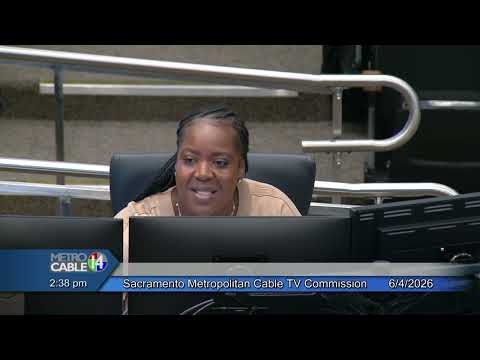
The Sacramento Metropolitan Cable Television Commission voted on June 4 to adopt a preliminary fiscal-year 2026-27 budget and to establish a short-term Finance Working Group and two ad-hoc committees to validate budget assumptions and recommend longer-term structural changes.
Sean Ayala, the commission’s executive director, told the board the commission faces falling cable franchise revenues: "Revenue last year was about $7,997,868," he said, noting expenditures of roughly $3.4 million, a 27% vacancy rate, and a carry-forward balance resulting from underspending. Ayala warned the commission that PEG (Public, Educational and Government) requests submitted for the coming year total about $4.22 million against PEG carry-forward and reserves, and that approving large requests now depends on future revenue streams.
The budget matter spurred an extended public comment period. Dozens of residents, producers and licensees urged the commission not to cut funding that supports community media, workforce training and local storytelling. "Access Sacramento has become my portal to becoming a filmmaker," Thomas Spencer said, describing low‑cost classes and equipment access. Hester Wagner, chair of Access Sacramento’s board, urged greater transparency in budget materials: "The lack of including the revenue in the slides that we just saw is a really important piece of the puzzle," she said.
KVIE President and General Manager David Lowe told the commission PEG funding must continue to support public and educational access as well as government access: "If revenues decline, we should all share in that reality together," he said, urging a balanced approach. Pete Coletto, finance director for the City of Sacramento, said member agencies should not be asked to shoulder the entire financial impact and flagged several budget assumptions—including supplemental OPEB payments and salary/benefit line items—for further review.
After questions and discussion, Chair Spease proposed adopting the FY2026-27 budget as drafted to ensure continuity of operations while commissioning three review efforts: a voluntary Finance Working Group to perform technical financial analysis and validate assumptions; an existing Budget Ad‑Hoc Committee to review findings and propose amendments; and a Strategic Ad‑Hoc Committee to evaluate the long‑term operating model and revenue sharing method. The chair outlined a timeline for reviews and reporting: preliminary budget amendments, if any, could return to the commission at a special consideration on Sept. 3, 2026, and the Strategic Ad‑Hoc Committee was to return recommendations by March 4, 2027.
Director Sloan seconded the motion. After additional discussion about committee membership and Brown Act limits on ad‑hoc bodies, the commission approved the motion. The chair announced the item passed with the members present voting yes.
The action buys licensees runway to pursue sustainability plans while the working groups and ad‑hoc committees examine revenue assumptions, encumbrance practices for PEG projects and distribution methods. Sean Ayala summarized how JPA members’ capital projects are encumbered and reimbursed upon invoice submission, and warned that if future revenue remains materially below projections the commission will need to consider partial reimbursements or other adjustments.
Next steps: the Finance Working Group will convene with Metro staff and interested member‑agency finance staff to analyze agency contributions, revenue assumptions and benefit/OPEB calculations. The Budget Ad‑Hoc will review the working group’s technical findings and may present recommended amendments at the Sept. 3, 2026 commission meeting. The Strategic Ad‑Hoc will study longer‑term governance and revenue distribution and report back by March 4, 2027.
The vote does not finalize allocations; it approved the preliminary budget to maintain operations and directed transparent, time‑boxed review and community participation in the coming months.