Get Full Government Meeting Transcripts, Videos, & Alerts Forever!
Get email alerts on the Water Quality topic
No spam. Unsubscribe anytime.
Seminole County scientists use stream insects to track Howell Creek water quality
Summary
Seminole County environmental services teams conduct DEP-prescribed annual habitat assessments on Howell Creek, using macroinvertebrates and field readings (including a reported conductivity of 287.5) paired with monthly testing to monitor long-term water quality trends and advise residents on pollution-prevention steps.
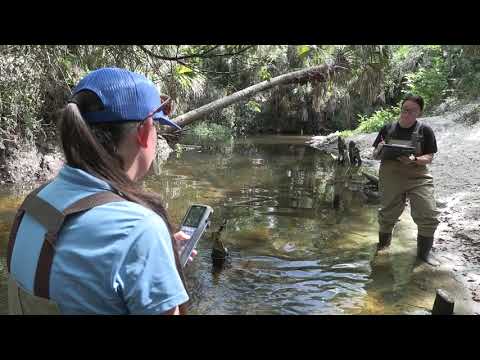
Seminole County environmental services teams are surveying Howell Creek and other local streams this season to assess water quality using a DEP-prescribed habitat-assessment method and biological indicators, a county scientist said.
The scientist said teams collect data on banks, water and the insects that live in the stream — so-called macroinvertebrates — because some species (caddisflies, mayflies, dragonflies and others) are highly sensitive to pollution and can indicate long-term health trends that a single water sample might miss. "Conductivity, 287.5," the scientist reported during the field check; the audio did not specify units for that reading.
The practice is part of an annual habitat assessment required by the Department of Environmental Protection, the presenter said, and those yearly surveys are paired with monthly water testing to give a clearer picture of how local waterways change over time. The scientist noted they still need to measure flow at the site before completing the assessment.
Biological indicators can reveal conditions that aren’t captured by short-term chemical samples because many aquatic insects live in a stream for months or years, the presenter explained. "We only find these in just a couple streams in the county," the scientist said of the Ranatra, a water scorpion, using the species’ limited local occurrence to illustrate habitat differences between waterways.
County staff and presenters emphasized the link between land use and stream health: "Everything that is on the ground can end up in our water," the presenter said, urging residents that even if a stream is not in their backyard they still live in a watershed. Practical steps listed for residents included following fertilizer guidelines, picking up pet waste and keeping debris out of storm drains.
The surveys combine biological observations and physical and chemical measurements to identify trends and potential issues. The county did not announce regulatory actions in the audio; the recording described routine monitoring and public-education guidance as next steps.