Get Full Government Meeting Transcripts, Videos, & Alerts Forever!
Get email alerts on the Water Quality topic
No spam. Unsubscribe anytime.
Lake restoration officials say constructed wetlands are removing tons of nutrients but toxin trends remain mixed
Summary
Teresa Durkson told the St. Marys City Council that constructed wetlands around Grand Lake St. Marys—funded in part by H2Ohio and Clean Ohio grants—have removed large amounts of nitrate and phosphorus, while ongoing monitoring shows variable toxin levels this year; future projects and nitrogen-focused grants were discussed.
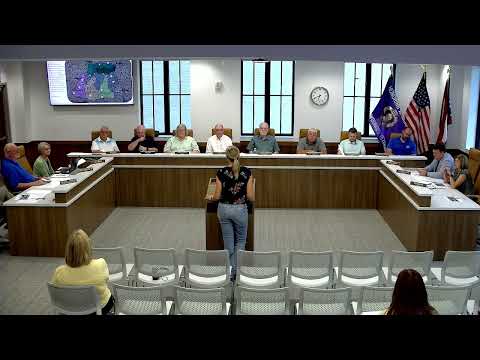
Teresa Durkson, project manager for the lake restoration commission and the lake facilities authority, told the St. Marys City Council that a network of constructed-wetland “treatment trains” around Grand Lake St. Marys is removing substantial nutrient loads from feeder creeks but that toxin (algal) measures this year have shown more variability than in recent seasons.
Durkson outlined projects including Prairie Creek, Cold Water Creek—the lake’s top-performing wetland system capable of pumping about five million gallons per day—and larger conservation efforts such as the 90‑acre Bartwood Landing Camp wetland. She said the lake projects have been supported by state and federal programs, noting an early H2Ohio grant of $1.7 million in 2021 that was stretched across multiple phases and sites.
“Because we are so efficient with our funds, that $1.7 million went a lot further than we had anticipated,” Durkson said, describing phased work that added multiple acres of wetlands and shoreline stabilization. She also described a recently acquired site (Redwing Nature Preserve) and a planned southeast-lake project estimated at about $1.1 million that could treat up to two million gallons per day when completed.
Durkson cited monitoring done in partnership with Wright State University’s lake campus and said peer‑reviewed research on several wetland projects has been published in the last two years. She said the combined monitoring shows cumulative removals of nutrients and sediment: “we're moving removing like 14,000 pounds of nitrate and several thousand pounds of phosphorus” from water entering the lake over time.
At the same time, Durkson said toxin (blue‑green algae) readings in 2025–2026 have been uneven. She attributed part of the variation to atypical winter biomass behavior and to drought and low lake levels earlier in the season: monitoring that normally drops to low biomass for several weeks this winter instead fell for only one week, then spiked back up. “That’s one factor we believe that's contributing to some of the higher levels we're seeing,” she said.
Council members asked whether additional major wetland projects are planned; Durkson said no large new wetland projects are immediately on the docket but that staff are pursuing grant applications focused on nitrogen reduction and are interested in cost‑share programs with farmers to reduce nitrogen inputs. She warned that rising land costs make future site acquisitions more difficult and emphasized the need to site wetlands close to creeks and to maintain places for dredge material placement.
Durkson also highlighted public information resources: a QR code and the grandltrails.com site list wetland locations, histories, walking opportunities and annual monitoring summaries. She invited council and the public to review yearly reports that quantify pounds of nitrate, phosphorus and sediment captured by the projects.
The council did not take any formal action on the presentation; Durkson answered council questions and noted that grant and construction timelines for the southeast-lake project are contingent on pending documentation and approvals.