Get Full Government Meeting Transcripts, Videos, & Alerts Forever!
Get email alerts on the Ev Fleet Resilience topic
No spam. Unsubscribe anytime.
County staff outline electric‑vehicle fleet strategy, charger expansion and resilience program next steps
Summary
County resilience and sustainability staff briefed the advisory committee on an EV fleet pilot (roughly six EVs and three hybrids in rotation, 22 county chargers with 12 public‑facing, eight chargers planned), a plan to right‑size fleet purchases, upcoming sustainability plan refresh and resilience metrics/training timeline. Staff called for coordinated outreach to private sector and municipalities.
County resilience and sustainability staff gave a progress update on the county’s electric‑vehicle (EV) fleet work, charger infrastructure and broader resilience and sustainability initiatives.
Kristoff, an intern in the county’s Resilience and Sustainability division, summarized findings from the county’s 2020 greenhouse‑gas inventory and staff proposals to reduce transportation emissions by transitioning low‑duty county vehicles to EVs and hybrids. He said the county is targeting low‑duty vehicles (those that drive less than ~2,000 miles per year for county administrative use) and described an EV rotation program that allows departments to test EV models — including compact EVs and plug‑in/crew trucks — through the motor pool.
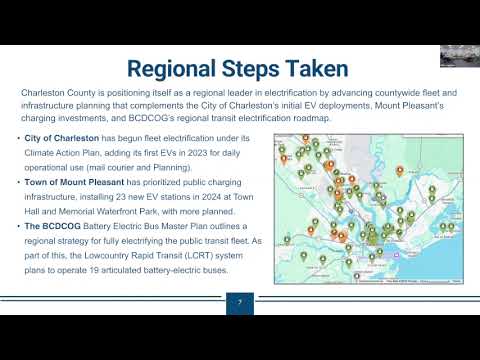
"We currently have roughly around six electric vehicles and three hybrids," Kristoff said, adding that this represents about 22% of the county’s early conversion target tied to a 5% transitional goal in the sustainability plan. He said the county operates about 22 chargers at county facilities — 12 of which are public facing at libraries and parks — and is installing eight additional chargers at two new county complexes (the Teddy Prior service building and the Aelia complex) to support fleet transitions by public works and other departments.
Kristoff described operational issues that affect EV adoption for some departments: limited charging infrastructure in rural parts of the county, range limitations tied to vehicle speed and use case, and battery‑management practices (staff cap charging around 80% to extend battery life). He said departments reported positive performance on some vehicles in off‑road or heavy‑use conditions but that broader adoption depends on additional chargers and site preparation (conduits and electrical service upgrades) at county facilities.
County resilience staff also updated the committee on the resilience collaborative: since February staff have held listening sessions with municipalities and internal county departments, hosted a resilience accelerator workshop, and compiled five key takeaways focused on aligning metrics with agency missions, addressing public distrust through shared data, understanding implementation tradeoffs, clarifying regional roles (housing was a prominent theme) and engaging the private sector. Staff outlined a timeline of trainings on an Excel‑based hazard/vulnerability platform in June–July, reconvening the collaborative in September to present draft KPIs, and seeking a publicly visible launch of the coordinated resilience metrics by December.
Ally, sustainability staff, summarized program updates: an extension and $15,000 addition to a residential weatherization grant (intended to provide audits and upgrades), a plan to refresh the county greenhouse‑gas inventory (currently based on 2020 data) with results expected by late October, continued progress on an energy savings performance contract (investment‑grade audit about 90% complete for several county buildings), and expanded county battery recycling and residential compost program administration.
Staff asked the advisory committee to help accelerate outreach to elected officials, business groups and other stakeholders. Suggestions during the meeting included presentations to regional boards (COG, chamber) and targeted one‑on‑ones with groups such as homebuilders and realtors to explain ordinance impacts and resilience tradeoffs.
Ending: Staff said they will proceed with planned trainings and KPI development this summer, continue charger installations at county sites, and coordinate with municipal partners on resilience and wetlands engagements.