Get Full Government Meeting Transcripts, Videos, & Alerts Forever!
Get email alerts on the Unified Development Ordinance topic
No spam. Unsubscribe anytime.
Newton County reviews major UDO rewrite; data centers, ADUs and conservation overlays prompt debate
Summary
Newton County commissioners and the planning board reviewed draft updates to the Unified Development Ordinance, including a new Technology Campus district for data centers, tightened ADU and tiny-home rules, revised subdivision procedures and changes to conservation overlays; commissioners raised parking, enforcement and housing-conversion concerns.
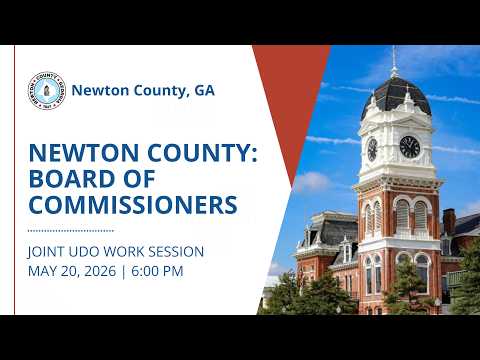
Newton County officials and planning commissioners held a joint meeting to review draft updates to the county’s Unified Development Ordinance, or UDO, focusing on how the proposed rules would regulate data centers, accessory dwelling units, tiny homes, chicken-keeping and subdivision review procedures.
"Tonight we're going to have a joint meeting tonight with our planning board," Vice Chair Leanne Long told attendees as the board opened the session. Planning Director Nisha Appleway introduced the agenda and turned the presentation over to consultant Brian Mabry of Kendis Collaborative. "This is our third presentation and update that we have for the unified development ordinance," Appleway said.
The consultant outlined a modular approach. Module 1 consolidates general provisions, measurement rules and definitions, base districts and the use table; Module 2 covers CORD (community-oriented residential development) provisions, overlay districts, countywide regulations (signs, landscaping, parking) and review procedures. Mabry said the project team aims to publish a public-review draft this summer and seek adoption later in the season, but stressed the drafts remain changeable until formal adoption.
A major substantive proposal is a new Technology Campus (TC) zoning district intended to regulate data centers and similar facilities. The draft also allows data centers with conditions in some existing industrial districts; the precise minimum lot size and where the use is permitted remain under discussion. Mabry described draft safeguards that include large minimum lot sizes (the draft cites a 300-acre baseline but advisory committee members suggested increasing that to 1,000 acres), a 1,000-foot side/rear setback from adjacent residential uses in some cases, a 90-foot maximum building height, substantial landscape buffers, limits on noise and heat, and requirements for technical verification from utility providers and licensed engineers.
The draft also adds a closed-loop cooling requirement and other environmental mitigation measures for large data-center proposals, and requires applicants to provide detailed, capacity-specific utility letters rather than generic approvals.
Commissioners and planning-board members raised questions about whether data centers should be allowed in office-institutional (OI) and light-industrial (M1) zones at smaller scales, or limited to the new TC and heavier industrial districts where larger minimum acreage would apply. Several participants urged the county to decide whether it intends to be "data-center friendly" and to set minimum-acreage and location policies accordingly.
The presentation included several other notable changes:
- Accessory dwelling units (ADUs): Draft standards distinguish attached and detached ADUs; floor area is limited to 50% of the primary dwelling or capped at 1,000 square feet, ADUs must provide a dedicated parking space and meet design-compatibility requirements. The advisory committee suggested increasing ADU setbacks from the current 20–25 feet to 40 feet in some circumstances.
- Tiny homes and container units: Tiny-home provisions were reinstated with tighter design and siting requirements; the draft currently requires tiny homes to be on sewer and staff said tiny homes should be on permanent foundations rather than movable units. Container homes are not specifically addressed in the draft; applicants would be required to submit engineered drawings for review.
- Use table updates and prohibitions: The draft explicitly prohibits certain uses (cryptocurrency/data mining, vape shops, and a newly listed halfway house definition) and adds or clarifies definitions for a range of uses, from micro-distilleries to hunting lodges and rental cabins.
- CORD (planned developments) and overlay policy: Module 2 proposes phased build-out rules intended to prevent residential development from completing without accompanying commercial components (example: applicants could complete up to two-thirds of planned residential construction but must build a threshold of commercial development before finishing remaining residential phases). The draft would also remove some automatic conservation-by-right options and restrict overlay stacking to avoid unexpected density increases in rural areas.
- Procedural updates: The draft would shift some preliminary-plat review away from a mandatory public hearing toward an applicant-facilitated neighborhood/community meeting that requires documentation (attendance, meeting notes) and then a planning commission decision; the change is presented as a policy choice that needs further direction.
During the question-and-answer portion, commissioners voiced several recurring concerns: investor-driven "build-to-rent" conversions that can concentrate rental ownership in subdivisions and depress nearby home values; perceived loopholes that allow increased density through overlay stacking; the practicality of enforcing stricter rules (most zoning enforcement is complaint-driven); and the need for detailed utility confirmations and qualified engineering reports for infrastructure-intensive proposals.
Planning staff and the consultant acknowledged those concerns and described draft fixes, including removing conservation development options in certain districts, returning density approvals to the board's discretionary review in some CORD cases, and tightening documentation requirements for utility capacity letters and engineer verifications.
There were no votes on UDO provisions during the meeting. The boards closed the joint session to proceed to a scheduled public town-hall engagement afterward. A procedural motion to adjourn the joint meeting carried by voice vote.
What happens next: the project team expects to publish a public-review draft and hold required hearings; any numeric standards (minimum acreage for TC, setback distances, ADU setbacks) remain tentative and subject to change through public input and board direction. The county has signaled it will continue targeted outreach and requested a work session so commissioners and staff can delve more deeply into disputed items before adoption.