Get Full Government Meeting Transcripts, Videos, & Alerts Forever!
Get email alerts on the Library Senior Center topic
No spam. Unsubscribe anytime.
Freetown approves $26.5 million library and senior center; final approval hinges on next week's debt-exclusion vote
Summary
Town meeting voters approved a $26.5 million appropriation to build a combined library, senior center and community building, contingent on a separate debt-exclusion ballot vote next Monday and subject to grant receipts and borrowing authorization.
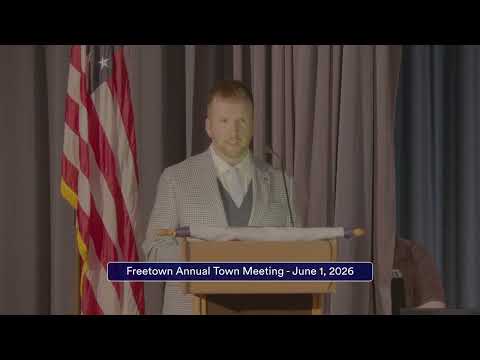
Voters at Freetown's annual town meeting on June 1 voted to authorize a $26,500,000 appropriation to construct a combined library, senior center and community building, with funding drawn from multiple sources and contingent on a two-part approval process that includes a debt-exclusion vote by town voters next Monday.
The appropriation calls for $6.5 million to be transferred from the capital stabilization fund and $3.0 million from overlay surplus, and authorizes the treasurer, with selectmen's approval, to borrow up to $17 million under Massachusetts General Laws, chapter 44, section 7. The article also allows the town to apply for and accept grants and loans, including a Massachusetts Board of Library Commissioners grant of $9,879,645; any grant received would reduce the borrowing authorization by the same amount.
The project prompted extended public discussion. Frank Ashley of East Freetown told the meeting that projected operating costs for staffing, utilities, groundskeeping and maintenance could be much higher than the estimates provided and argued the town needs clearer operating-cost projections before committing. "Without the projected costs, I don't believe we can have an educated vote," Ashley said.
A town spokesperson and project lead (the selectmen's representative at the meeting) responded with line-item estimates they said were conservative. They estimated part-time general staffing at about $45,000 annually, electric costs about $150,000, a placeholder for heating/oil at $15,000, groundskeeping and maintenance at about $55,000, and an insurance increase of about $20,000. The presenters said the net increase in annual operating costs was estimated at roughly $295,000, and that a projected Amazon TIF (tax increment finance) revenue of about $250,000 a year would reduce the net impact to roughly $45,000 annually.
Supporters emphasized the rare availability of state funding and local need. Denise Lamoreaux urged voters not to let the MBLC grant be allocated to other towns, saying, "We have one chance at all of this money and it is right now." Several residents described current library facilities as undersized, lacking running water, or otherwise inadequate for programming. Jill LaRue, a resident, clarified that the borrowing would be via a debt exclusion (a temporary override) and not a permanent increase under Proposition 2—, noting the extra levy would expire after the borrowing is retired.
The moderator announced a motion to vote by secret ballot; the meeting initially used electronic "clicker" devices for the secret ballot but encountered technical problems (a discrepancy between the number of registered voters checked in and clicker responses). After troubleshooting and reports of devices not registering, the meeting transitioned to paper voting tickets and a counted vote. The moderator declared Article 6 adopted by the required two-thirds vote. The article must also be approved at a debt-exclusion election scheduled for the following Monday for the project to proceed.
If either step failseither the town meeting vote or the debt-exclusion ballotthe appropriation will not advance. Project proponents stressed that nearly $10 million in state grant funding is at stake and that some components (such as required square footage) are driven by grant conditions.
What's next: the article's adoption at town meeting authorizes the appropriation but the borrowing and the actual debt exclusion require voter approval at the scheduled election; grant receipts will reduce borrowing needs if awarded.