Get Full Government Meeting Transcripts, Videos, & Alerts Forever!
Get email alerts on the Data Centers topic
No spam. Unsubscribe anytime.
Wythe County residents press supervisors to halt data centers as Fluid Stack presents Solless Arcs plan
Summary
Residents at the June 9 Wythe County Board of Supervisors meeting urged the board to block data-center development, citing water, health and environmental concerns. Fluid Stack, new owner of the Solless Arcs project at Progress Park, presented technical and economic assurances and the board approved an administrative estoppel statement for the site.
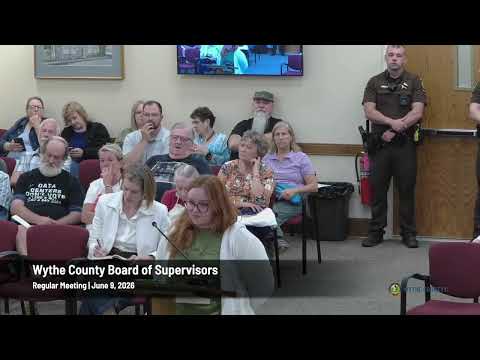
Residents filled Wythe County’s board room on June 9 to press supervisors to stop or slow proposed data-center development, while Fluid Stack — the recent purchaser of the Solless Arcs project at Progress Park — presented details about how its facility would operate.
Katherine Clemens, a local resident, told the board: "You have decided to betray your own community," and accused supervisors of trusting developers, holding closed-door meetings and signing nondisclosure agreements instead of answering constituents’ questions. Miranda Edwards, who identified herself as holding a master’s in public health, raised concerns about "massive electric demand," "hazardous chemical leaks," noise pollution and heat-island effects from AI-scale facilities. Denise Davis cited drought data and USDA agricultural numbers and asked who would get water if data centers began using large supplies.
Those speakers were among more than a half-dozen residents who referenced petitions and online groups that, together, have gathered thousands of signatures opposing large-scale data centers and called for land-use protections and public transparency.
Representing the developer, Kate Franco of Fluid Stack told the board that Fluid Stack recently closed on the land and is committed to documented contractual protections, regulatory permits and local compliance. Franco explained why modern hyperscale facilities differ from earlier data centers and described the company’s planned cooling strategy. "A closed-loop system genuinely does use less water than a traditional evaporative cooling method," she said, adding that the "average daily usage becomes approximately equal to that of seven or so average homes." She also said the company would pay for any required utility upgrades and would hire locally.
County staff and the county attorney described a pending administrative estoppel statement — an internal certification that, at present, the Progress Park parcel is in compliance with existing park covenants and does not show violations. Several residents asked the board to postpone any administrative approvals until a full site plan is submitted. County staff emphasized that a site plan is still required and remains the mechanism through which the county can impose or withhold building permits.
Despite public opposition, the board approved the estoppel statement after staff and counsel said no covenant violations currently exist. The motion to approve the estoppel statement was made by Mr. Cook and seconded by Mr. Bernett; the board carried the motion.
Why it matters: Speakers and residents argued that hyperscale AI data centers present novel environmental and infrastructure challenges compared with older, smaller data centers — in particular, concerns about long-term water use in an area experiencing drought, potential impacts on farmland and wildlife, and limited local legal mechanisms to restrict purchases made through corporate proxies. Developers countered with operational assurances, planning commitments and promises of jobs and local investment.
What’s next: Staff said the project still requires a formal site plan showing specific mitigation measures (stormwater, landscaping, noise, lighting and screening), and that the board’s approval of an estoppel statement does not replace the site-plan review or building-permit process. Several supervisors also proposed short-term task-force work with school-board representation to prepare to allocate any future tax revenue from large projects toward capital needs such as schools, roads and public safety.
The board did not adopt land-use zoning changes at the June 9 meeting; planning staff scheduled a planning commission work session for June 22 to review public input and next steps for the land-use ordinance. The county also faces separate proposed projects (including a privately sold thousand-acre site discussed by residents) that have amplified calls for stronger land-use controls and public hearings.