Get Full Government Meeting Transcripts, Videos, & Alerts Forever!
Get email alerts on the Human Services Grants topic
No spam. Unsubscribe anytime.
City of Lacey staffer Michelle Chavez outlines 2026 human services grant application, deadlines
Summary
Michelle Chavez led a webinar for nonprofits explaining eligibility, priority areas (affordable housing, homelessness and youth services), award limits ($50,000 capital, $30,000 services), the June 26 4 p.m. deadline and presentation and scoring procedures for the Human Services Commission.
Michelle Chavez, a City of Lacey staff member, led a webinar to walk nonprofit organizations through the 2026 Human Services Grant Program application process, eligibility rules and submission deadlines. "The grant is open to only to nonprofits," she said, and stressed that capital projects must be physically located in Lacey.
Chavez front-loaded key deadlines and award levels: applications are available online and due June 26 at 4 p.m.; the maximum capital award is $50,000 and the maximum public-service award is $30,000. She reiterated, "We do not accept late applications," and advised applicants to contact staff immediately if an emergency threatens on-time submission.
The program year runs Sept. 1, 2026, through Aug. 31, 2027. Chavez explained the application is submitted in Smartsheets and warned that Smartsheets does not save partial entries: "I recommend... have your questions prepared, like your answers prepared, like in a word document or something," so applicants can paste answers into the form in one sitting.
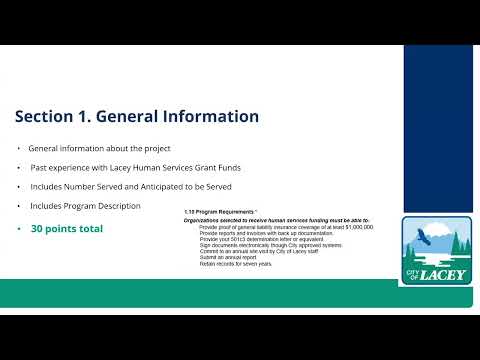
She reviewed the four application sections and their weights: Section 1 (general information) 30 points; Section 2 (organizational overview) 35 points; Section 3 (project overview) 20 points; and Section 4 (budget) 15 points. Chavez said the Human Services Commission (seven commissioners plus an optional Lacey Youth Council member) will score applications, hold public presentations July 1 (3 p.m.) and July 2 (5:30 p.m.), then make recommendations to the city council, which has final authority on awards.
On reporting and payment procedures, Chavez confirmed the program is cost-reimbursement: the city reimburses documented expenses after services are rendered. She said quarterly reports typically accompany invoices but there is no single fixed reporting date; agencies that invoice once may submit an annual report.
Required attachments include the program/project budget using the city form, a current board list, IRS tax-exempt documentation (Form 990 or equivalent), and the current operating budget income-and-expense report. Chavez also noted recipients must name the City of Lacey as an insured party on liability insurance and retain records for seven years for auditing.
On eligibility clarifications, Chavez gave examples: a critical home repair program that performs work only in Lacey would be considered a service project rather than a capital project; by contrast, an application to expand a shelter building would be a capital project and the physical structure must be located in the city. She said she will follow up to confirm whether fiscal sponsorships are permitted under the policy since the typical requirement is that the applicant be an established 501(c)(3).
Chavez said she will post the cleaned scoring rubric, slides and the webinar recording on the City of Lacey grants webpage and invited applicants to contact her with questions. She provided contact information for follow-up: Michelle.Chavez@cityoflacey.org and the office phone number she listed during the webinar.