Get Full Government Meeting Transcripts, Videos, & Alerts Forever!
Get email alerts on the Pool Electrification topic
No spam. Unsubscribe anytime.
Brisbane unveils what officials say is California’s first electrified municipal pool
Summary
Brisbane officials and project partners marked a ribbon-cutting at the city’s community pool, which city and partner speakers described as the first municipal pool in California to replace gas heating with an all‑electric heat‑pump system; officials cited a projected 86% drop in gas use and roughly $15,000 in annual savings.
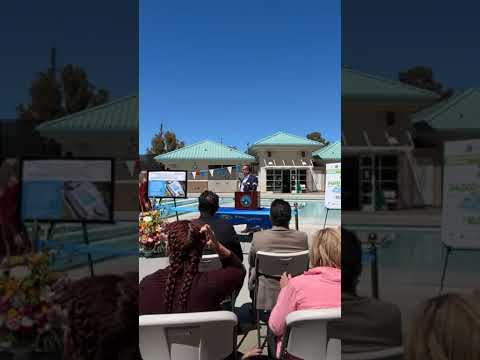
Brisbane officials and project partners onstage at a ribbon-cutting celebrated the city’s community pool retrofit, which they said is California’s first municipal pool to shift primary heating from natural gas to an all‑electric heat‑pump system.
"We ordered this weather like this," Mayor Pauline Mazen said as she welcomed attendees and praised the project’s collaborative partners and city staff. The crowd applauded as officials described the yearslong effort to design, fund and build the retrofit.
Supervisor Don Horsley thanked local leaders and called the pool a model for other communities, saying, "this is going to be a model throughout the state of California and the United States." Horsley also credited county Measure funds for helping finance the project; the transcript identifies a $200,000 county contribution but inconsistently names the specific county measure.
Martin Medina, chair of the Peninsula Clean Energy board, said the project was enabled in part by PCE incentives and loans and described the expected operational gains: "This project is expected to save $15,000 annually in operating costs while reducing the facility's natural gas use by 86%." Medina framed those figures as projected savings tied to the electrification and partnership incentives.
Adrian Nelson, the city’s sustainability manager, gave a brief history of the work: the pool entered a zero‑net‑energy study in 2018, staff pursued technical assistance and incentives, and the City Council approved the project in July 2022 under a design‑build contract using Government Code 4217. Nelson outlined engineering and site constraints — locating large heat‑pump units, running new electrical service and adding a transformer pad — and credited coordination with PG&E, the school district and several subcontractors for keeping pool disruptions minimal.
Officials and staff named multiple partners on the record, including Peninsula Clean Energy, PG&E (for new service and a pole), Willdan (technical assistance under PG&E’s implementer program), and local contractors who completed installation and commissioning. City staff also thanked pool managers and parks and recreation workers who kept the facility operating through construction.
City and partner speakers emphasized community benefits beyond emissions reductions: officials said the retrofit preserves the pool as an accessible public space for families, swim lessons and recreation and frees operating dollars that could be reinvested in programs. The ceremony closed with a countdown and a ceremonial ribbon cutting to mark the project’s completion.
Officials’ next procedural steps were not specified in the remarks; speakers said the system is installed and staff are operating it but did not give a timetable for monitoring or public reporting on realized savings.