Get Full Government Meeting Transcripts, Videos, & Alerts Forever!
Get email alerts on the Education Policy topic
No spam. Unsubscribe anytime.
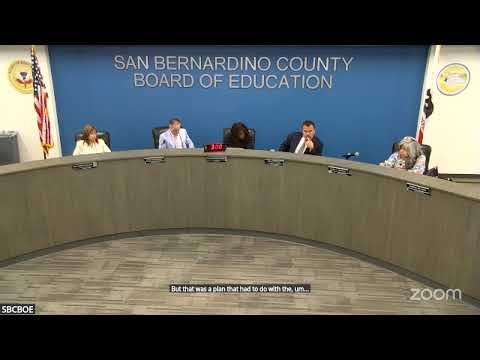
Board adopts LCAP after local‑indicator presentation amid questions on literacy and data access
Summary
The San Bernardino County Board of Education received the required LCFF local‑indicator presentation and adopted the county office 2026–27 LCAP. Board members and public commenters pressed staff for more accessible dashboard data and urged a stronger focus on early literacy and reading remediation.
The San Bernardino County Board of Education on June 8 received the county office’s local indicator presentation and voted to adopt the San Bernardino County Office of Education (SBCSS) 2026–27 Local Control and Accountability Plan (LCAP).
Why it mattered: State rules require districts and county offices to present local indicators—such as STAR testing outcomes, school climate measures, and foster‑youth tracking—at the same meeting as adoption of the LCAP. Staff explained how alternative‑education LCFF base grants and concentrated supplemental funds are presented under state calculations.
What staff reported: Student services leaders said SBCSS met multiple priorities—credentialed teachers, access to adopted instructional materials, PBIS implementation and a program of positive behavior supports, online A‑G curriculum access and dual‑enrollment options, and monthly coordination to reduce exclusionary discipline. The foster‑youth coordinating program serves roughly 6,000 youth annually and runs a three‑year grant cycle with an advisory council of agency partners.
What board members pressed staff to clarify: Multiple trustees asked where the numeric dashboards and metric determinations were posted and how the local‑indicator self‑reflection tool was used. One board member pointed to state guidance that requires LEAs to report the data used to produce local‑indicator results at the meeting where the LCAP is adopted; staff said numerics are in the LCAP packet and posted online but agreed to add clearer access paths. A separate line of questioning asked staff to explain the state’s LCFF calculation that makes the county’s supplemental concentration funds appear small (about 9%), while county staff said the effective share directed to alternative‑education students is closer to one‑third when local operations are excluded.
Public comments and literacy focus: Parents and staff urged a sharper literacy emphasis. Speakers, including teachers who have piloted reading interventions, said screening (STAR) and in‑school interventions are in place but called for more remediation tools and broader rollout of evidence‑based programs such as Lindamood‑Bell or other literacy interventions appropriate for alternative‑education settings. Board members repeatedly asked staff to “front‑load” literacy in the next LCAP cycle: "I literally want to see the word literacy on every page," one trustee said.
Vote and next steps: After discussion the board adopted the 2026–27 LCAP (recorded vote on meeting transcript). Staff will submit the LCAP to the California Department of Education within required timelines, and several trustees asked staff to return with clearer dashboard links, the state self‑reflection evidence, and plans for targeted early‑literacy interventions and associated costs.
What the transcript does not show: The meeting record captures the presentation and adoption and the board’s request for clearer public access to the data. It does not include later staff follow‑up documents; trustees asked that requested materials be provided in board correspondence.