Get Full Government Meeting Transcripts, Videos, & Alerts Forever!
Get email alerts on the Subdivision Regulations topic
No spam. Unsubscribe anytime.
Attorney urges change to subdivision street language, cites court precedent; commission closes hearing
Summary
At a June 9 East Granby Planning & Zoning meeting, an attorney for the McNottton trust urged a text amendment to clarify when proposed subdivision streets must intersect 'town' roads, arguing the current phrasing creates unequal treatment of landowners and may exceed statutory authority; the commission closed the hearing and staff advised seeking fire, traffic and town‑attorney review before action.
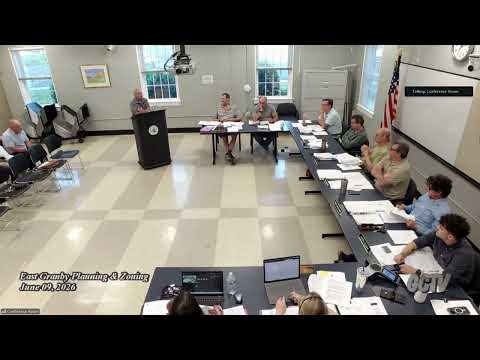
An attorney representing the Robera McNottton Trust urged the East Granby Planning and Zoning Commission on June 9 to amend a subsection of the subdivision regulations that requires proposed streets to intersect a "state highway or an existing or approved town street." Carl Landolina told the commission that using the word "town" in that provision — a term he said appears only there and not elsewhere in the design standards — creates an ambiguity between public and private roads that can produce disparate treatment of property owners.
Landolina said the ambiguity matters because some town subdivisions use private roads built to town construction standards but not maintained by the municipality. He argued the language could prevent owners who only have frontage on private roads from pursuing subdivisions in the same way owners with public-road frontage may, and he cited Andrews v. Planning and Zoning Commission (Town of Wallingford) (2006) to underline his point that a commission may not impose requirements beyond what state enabling statutes expressly grant.
Commissioners asked technical and policy questions about whether private roads built to town standards are functionally different from public roads, how "approved" should be interpreted, and whether additional safety input was necessary. Staff advised that traffic, fire-department and town‑attorney review would be useful before the commission takes any regulatory action. The chair said action on the amendment was "highly unlikely" that evening; the public hearing was closed by voice vote and the item will return to the commission with any requested departmental input and a legal opinion.
Why it matters: The precise wording of subdivision regulations determines which properties can be developed and under what conditions. If the commission or town attorney agrees the current wording lacks a clear statutory basis, the town may revise the language to avoid legal vulnerability and to ensure equitable application across properties with private or public access.
Next steps: Staff recommended obtaining written input from the fire department and traffic review, and obtaining a town‑attorney opinion on the legal scope of the commission's authority before the commission considers a draft amendment for decision.