Get Full Government Meeting Transcripts, Videos, & Alerts Forever!
Get email alerts on the Elementary Education topic
No spam. Unsubscribe anytime.
Witas principals outline 'growth mindset' strategies, 10‑minute math fluency and new dashboard
Summary
At the June 8, 2016 Othello School District board meeting, Witas Principal Justin Johnson and assistant Sheamus McPartland described a districtwide push—11 instructional 'non‑negotiables,' a 10‑minute daily 'spring math' fluency program, and a live data dashboard that tracks student mastery by skill.
Justin Johnson, principal at Witas Elementary, and assistant Sheamus McPartland told the Othello School District board on June 8 that the school has adopted a growth‑mindset approach and a set of 11 "non‑negotiables" to guide instruction and school culture.
Johnson described a short, daily intervention known in the presentation as "spring math," which the school uses as a prevention program to build mathematical‑thinking fluency. "All kids in core get it; it takes about 10 minutes a day," Johnson said, explaining the work focuses on number sense and fact fluency so students enter middle school ready for algebraic thinking.
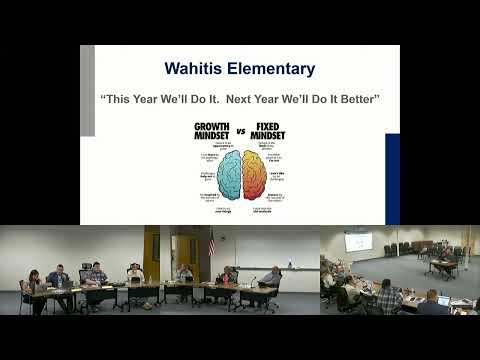
Why it matters: Johnson and Sheamus said strengthening basic number sense reduces long‑term learning gaps. "Today we'll do it. Tomorrow we'll do it better," Johnson said, summing the growth‑mindset emphasis that guides teachers to pilot, refine and scale practices.
Sheamus McPartland described the school's approach to progress monitoring, which he called "aggressive monitoring." He said teachers track specific skills on weekly sheets and must respond to what the data show rather than merely collect it. Those monitoring sheets feed a live dashboard the presenters demonstrated, which aggregates mastery percentages by skill and grade and, they said, is accessible to teachers and parents. As an example, Johnson cited "about 80‑some odd percent" mastery on an early‑kindergarten skill in the first week of monitoring.
The presentation also covered the district's evolving professional learning community (PLC) schedule, a shift toward more teacher‑driven collaboration and the use of scaffolded "accountable talk" sentence stems to increase classroom discussion and learning. The presenters said the same systems are being adapted for special‑education settings so teachers and paraprofessionals use consistent prompts and expectations across classrooms.
Board members asked whether the term "aggressive" reflected a problematic tone for younger students. McPartland and others clarified the intent: frequent, disciplined checks to inform instruction rather than punitive measures. Board members praised the site visit and the school's relational approach to students and staff.
The report required no district action; presenters answered questions and the board thanked them for the report.