Get Full Government Meeting Transcripts, Videos, & Alerts Forever!
Get email alerts on the School Budget topic
No spam. Unsubscribe anytime.
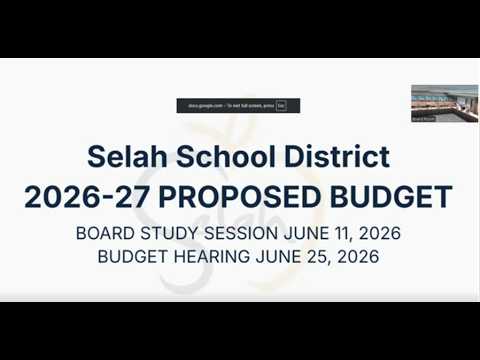
Selah School District previews 2026–27 budget, projects $732,000 shortfall and staffing reductions
Summary
At a mid‑June study session, district staff presented a 2026–27 budget that projects a $732,000 general‑fund deficit, highlights a $1.1 million special‑education shortfall and describes 27.2 positions cut through attrition; staff urged formal adoption at the upcoming business meeting to meet an accounting system migration deadline.
At a mid‑June study session, Selah School District staff presented the proposed 2026–27 budget and warned the board the district still faces a projected $732,000 general‑fund shortfall despite recent reductions and reallocation.
Stephanie, a district finance presenter, told the school board the general fund shows projected revenues of about $67.7 million and expenditures of roughly $68.5 million, leaving a $732,000 gap and an ending fund balance near $8.9 million (about 13%), above the district policy minimum of 8%.
The nut‑graf: staff said the district must balance three pressures—declining enrollment, expenditure growth (particularly salaries and benefits) and state funding that does not fully cover local salary schedules—and recommended adopting the budget at the board’s business meeting so the district can complete its migration to a cumulative accounting system in July.
Staff emphasized enrollment decline as the chief driver of the gap. Chris, a district staff presenter, showed enrollment falling from a 2023–24 peak of 3,693 to a planning figure of 3,468 for 2026–27 and projected an additional 262‑student decline through 2029–30. Staff estimated roughly $10,000 of revenue lost per student when modeling long‑range scenarios.
On revenues, staff said about 55% of district income comes from the state basic education apportionment, 21% from state special programs (including LAP and bilingual/transitional programs), 8% from federal sources and 13.1% from local taxes and local effort assistance (LEA). Staff noted the current levy expires in 2027 and warned the district would lose associated LEA funding if voters do not reauthorize it.
Stephanie and Chris reviewed expenditures and program pressures. Special education is projected to run a $1.1 million deficit because state allocations do not match the per‑student costs and the district must contract for scarce specialists such as occupational and speech therapists. Substitute and classified substitute costs are also materially underfunded, contributing roughly $1.7 million in net cost the district must cover locally.
The presentation outlined reductions already made through the budget process: a net 27.2 staffing positions removed (11 certificated, 2.2 administrative and 14 classified) plus about $270,000 in reallocated resources and operating cuts. Staff said those reductions have largely been accomplished through attrition so far and cautioned that any formal reductions in force (RIFs) would follow collective‑bargaining rules and could be disruptive.
On the meals program, staff announced the district will continue offering all students meals at no cost for 2026–27 and will use approximately $300,000 in carryover food‑service funds to cover a high‑school reimbursement gap for one year; staff described that as a one‑year solution, not a recurring revenue source.
Chris reviewed other funds and capital planning: debt service revenues of about $4.2 million support two outstanding bonds with $54.5 million remaining; capital projects will fund a turf field and a CTE addition with projected 2026–27 capital expenditures around $4.6 million and an expected post‑project capital balance in the mid‑hundreds of thousands. Staff proposed resuming $100,000 annual transfers to capital projects to rebuild facility reserves for roofs, HVAC and other maintenance.
Board members asked about recruitment of out‑of‑district students, potential impacts on class sizes and the mechanics of RIFs. Staff said the district prefers to grow programs to attract families rather than actively recruit from neighboring districts, and reiterated that formal RIFs would follow seniority procedures required by contracts.
The presentation closed with staff asking the board to consider approving the budget at the business meeting in two weeks so the district can complete the accounting migration and finalize the levy/forecasting work. The board had no further questions and adjourned.
Next steps: staff will post the full budget, four‑year forecast and citizen materials to the district website and present the formal budget for action at the business meeting required by statute.