Get Full Government Meeting Transcripts, Videos, & Alerts Forever!
Get email alerts on the Grant And Projects topic
No spam. Unsubscribe anytime.
Richmond Rising committee reviews progress on $35 million grant, outlines tree-planting, transit and solar projects
Summary
Richmond Rising and City of Richmond staff reported on spending and progress for neighborhood projects funded by a $35 million grant, including tree planting, a wellness trail, an e-bike program, and a multi-project Bay Area Air District grant application; the meeting also previewed a public dashboard and evaluation.
Vanessa Kente, facilitator of the Richmond Rising committee, opened the meeting and reviewed the group’s advisory role for a $35 million grant intended to benefit the Coronado, Santa Fe and Triángulo de Hierro neighborhoods.
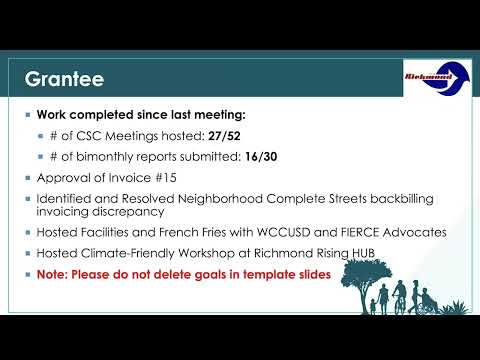
Matías, speaking for the City of Richmond, said the city administers the grant funds, submits bi-monthly reports and is processing invoices; he reported completed reimbursements of about $200,000 and that invoice #16 is being prepared. “La ciudad de Richmond es la que administra estos fondos,” Matías said, describing coordination with contractors and state environmental regulations.
Project leads gave status updates across multiple initiatives. Matías said design for phase one of the Harbor Way complete‑streets project (McDonald’s to Hoffman Boulevard) is about 95% complete and that $114,000 has been spent so far; environmental review and coordination with transit and highway agencies are ongoing. The Richmond Wellness Trail has expended a little over $500,000 of an approximately $5 million budget and remains behind schedule, Matías said, with further design and environmental review planned.
Urban Tilt presented several community programs. The shared e‑bike pilot is funded through fiscal 2026 after a City Council extension; project staff said the program has spent about $600,000 and has roughly $392,000 remaining. The community garden will begin construction June 10 with a July 9 opening ceremony, and Urban Tilt reported water‑conservation installations that saved an estimated 24,000 gallons across three homes.
Bosque del Barrio reported it aims to plant 1,000 trees in qualifying neighborhoods and has planted roughly 400 to date, with 18 trees planted last month. “Ya casi vamos a la mitad del proyecto,” the Bosque del Barrio representative said, and the group is recruiting a program manager.
Resilient Homes and related workforce programs reported continuing grant applications, twice‑weekly summer workshops and placement activities for youth. Presenters emphasized coordinating with the city to use remaining funds efficiently and to update a public project dashboard that is currently in testing.
Jim Becker presented a voluntary contribution concept (the “Shumi” land contribution) that would allow organizations to donate to Indigenous communities affected by land dispossession. Becker suggested Richmond Rising consider a modest donation from the grant funds as a form of reparative support.
Ari, a university representative listed in the transcript as from the “Universidad de Berkley,” said the university team is compiling records and has completed a two‑year evaluation report; the team will provide an interactive dashboard and has asked the committee for feedback via a forthcoming questionnaire.
Presenters also described a separate Bay Area Air District grant application (roughly $15 million) that would fund tree planting (600 trees), a transit‑pass pilot for 100 residents, roof repairs to enable solar installations, a battery storage pilot, and a roughly $3 million proposal to rebuild or replace the former Martin Luther King community center for use as a disaster refuge and programming hub. The application also includes respiratory health home visits, youth environmental‑ambassador training and workforce development components; the university team would evaluate outcomes.
Why it matters: the committee oversees community‑facing projects that can affect local air quality, active‑transportation access, youth job training and neighborhood resiliency. Staff said the dashboard and annual (or on‑request semiannual) updates are intended to make progress and budgets more transparent to residents.
What’s next: committee members were asked to review the dashboard prototype and expect a questionnaire to collect feedback; the e‑bike project team will present to City Council on June 16; staff will continue invoice processing and design work for Harbor Way and other capital projects.