Get Full Government Meeting Transcripts, Videos, & Alerts Forever!
Get email alerts on the Grant Funding topic
No spam. Unsubscribe anytime.
Richmond Rising partners outline $35 million package and pursue $15 million Catalyst grant
Summary
At a monthly Richmond Rising CSC meeting, partners reviewed progress across projects funded by a $35 million Transformative Climate Communities grant and described a combined application to the Bay Area Air Quality Management District (Catalyst grant) that would add 12 projects if awarded.
Richmond Rising partners and the City of Richmond used their monthly Collaborative Stakeholder Committee meeting to report progress on a $35 million Transformative Climate Communities (TCC) grant and to preview a bundled application to the Bay Area Air Quality Management District’s Catalyst program.
Matias Brock, co-lead for the City of Richmond, said the city and six local organizations administer the TCC grant and that the committee’s role is advisory: “This collaborative stakeholder committee provides guidance on project implementation and holds us accountable in reaching our goals. We can make recommendations, provide input, and assist project leads in implementing project ideas. We do not have final decision-making authority.”
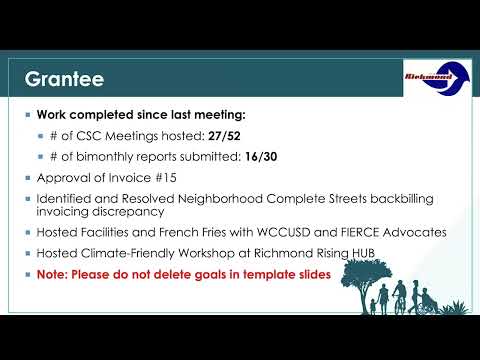
Partners outlined a wide portfolio of projects across transportation, housing, open space and workforce development. City staff said they had submitted the 16th bimonthly report and invoice and noted that invoice 15 had been approved; reimbursements to partners are on a delayed schedule. Brock reported that the city is working to recover about $200,000 in back reimbursements related to the Neighborhood Complete Streets project.
City staff described a preliminary application, dubbed “Richmond Rising Together,” to the Bay Area Air District’s Catalyst program (a $15 million total pool in the district application). The package submitted by Richmond would fold in 12 projects, with line-item budgets provided in the presentation. Examples included a tree-planting and rain-garden project (budgeted at just over $2 million), a transit-access pilot with up to 1,500 unlimited-ride passes ($1.1 million), a year of the Richmond Moves on-demand rides (just over $1 million), a roof-repair program to enable residential solar installations (just over $2 million), a mobile energy storage unit ($278,000), and a $3+ million design effort for a Martin Luther King Jr. Resilient Community Center.
Alicha Bruno of the UC Berkeley evaluation team said her group had published the Year Two report and is testing an interactive dashboard to help partners visualize progress against targets — for example, a project target of 250 residential solar installations — and asked partners to review the dashboard before it goes public.
The city said it expects the Catalyst program to announce awards in the fall and asked partners to be ready to coordinate closely if Richmond is selected. Jim Becker, speaking later in the meeting, urged committee members to consider voluntary contributions to Indigenous-led land restitution efforts as a complement to the committee’s land acknowledgement.
Next steps: the city will continue responding to state invoice comments, finalize amendments to the TCC package, solicit partner feedback on the evaluation dashboard and await the Bay Area Air District decision timeline in the fall.