Get Full Government Meeting Transcripts, Videos, & Alerts Forever!
Get email alerts on the Infrastructure topic
No spam. Unsubscribe anytime.
SAM staff outlines repeated CIP overruns and proposes clearer reporting and contingencies
Summary
Staff told the Sewer Authority Mid‑Coastside board that multiple recent capital projects exceeded original budgets because of long lead times, supply‑chain impacts and unforeseen scope changes discovered during construction; staff proposed clearer reporting, a new non‑CIP capital line and benchmarking with similar JPAs.
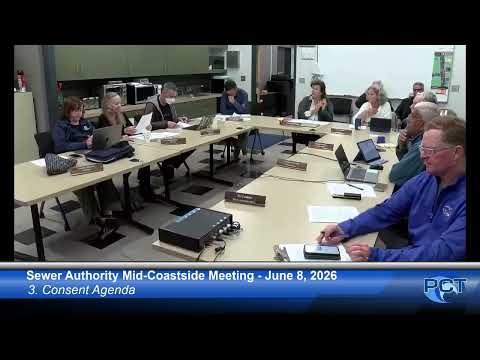
Staff presented a multi‑project post‑mortem to the board on June 8 describing why several recent capital projects ran over budget and what the agency will do to reduce future overruns.
Kishan said long equipment lead times and construction‑time scope changes were the primary drivers. He gave multiple project examples, including the aeration basin diffuser (budget $416,000; total expenditure $690,755, overage ≈ $275,000), bar‑screen and headworks replacements (budget ≈ $216,320; total ≈ $740,000; overage ≈ $524,000), influent pumps and motors (budget ≈ $468,000; spent ≈ $650,000; overage ≈ $182,000), and the number‑three water pump (budget $250,000; total $530,000; overage ≈ $279,000). Staff described common patterns: equipment ordered well before installation, discovery of incompatible older conduits or control panels at installation, and necessary design changes to meet current code and safety standards.
The report also described the agency’s reserve policy and current position: required operating reserve roughly $2,321,211 and a reported surplus of about $465,398 as of May 31, 2026.
Directors praised the level of detail in the new reporting and asked staff to benchmark practices against other JPAs, to consider including contingencies or cost‑escalation indexes in project budgets, and to clarify timelines for when projects were identified, approved and actually executed. One director recommended creating a non‑CIP capital line for recurring equipment and incidental infrastructure costs; staff said a new budget line has been added for next year.
Board members and staff also discussed whether the agency should carry a larger project contingency and whether to restore a full‑time construction management function to avoid surprises.
What’s next: staff will refine reporting to include project timelines, pursue benchmarking with peer agencies and return with recommendations on contingencies and budget presentation.