Get Full Government Meeting Transcripts, Videos, & Alerts Forever!
Get email alerts on the Regulations topic
No spam. Unsubscribe anytime.
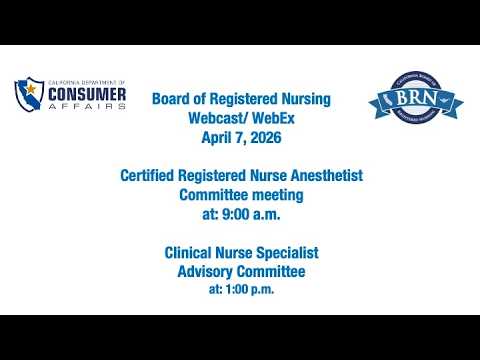
CRNA advisory committee approves draft regulations to implement AB876; physician groups warn of legal overreach
Summary
The CRNA Advisory Committee voted to forward proposed CRNA regulatory language implementing AB876 to the Board of Registered Nursing despite objections from the California Society of Anesthesiologists and California Medical Association, who said portions (responsibility/role and employer-directed language) exceed BRN authority.
The CRNA Advisory Committee voted to send a package of draft regulatory language to the Board of Registered Nursing to implement recent statutory changes affecting certified registered nurse anesthetists and APRN-to-RN delegation.
Sandra Bour, committee chair, described the draft as the first set of regulations to codify CRNA certification, trainee supervision, application processes, and a provision addressing nurse-anesthetist responsibilities and liability consistent with AB876. "This is a couple years in the works," Bour said during the discussion of the proposed text.
Lori, BRN staff, outlined the process: regulations require statutory authority and must mirror or be grounded in the Business and Professions Code. Staff said much of the draft focuses on operational rules (for example, defining the application form "prescribed by the board") and on clarifying that APRNs should be able to direct RNs without standardized procedures following recent statutory changes (citing AB890, SB1237, and AB876).
Public commenters were split. Dr. Kristen Roman of the California Association of Nurse Anesthesiology urged adoption and said the draft "reflect[s] a clear understanding of the CRNA role today." By contrast, Dr. Mark Toma (California Society of Anesthesiologists) and Lucas Evansson (California Medical Association) warned the regulation's nurse-anesthetist responsibility, role, and liability section appears to exceed the BRN's statutory authority and could affect employers and physicians outside the BRN's jurisdiction. "Regulations cannot be created without supporting statutory authority," Toma said, asking the board to remove terminology not present in AB876 and to remain within the "four corners" of statute.
Despite those objections, the advisory committee held a roll-call vote on the motion to present the draft to the Board; members recorded unanimous approval among those present (Chair Sandra Bour, Vice Chair Samantha Picowski, Karen Karp, Charles Griffith, Kathleen Theobald).
Why it matters: the committee's vote forwards regulatory language that would shape how AB876 is implemented in practice (including CRNA certification procedures and the practical interplay between APRN orders and RN execution). Physician groups signaled they will engage during the formal regulatory process to contest language they see as exceeding board authority.
What comes next: the draft will go to the Board of Registered Nursing for consideration in the formal rulemaking pipeline; public stakeholders (physician and medical associations, CANA) indicated they will participate in that process. The advisory committee also approved organizational changes (sunsetting a vacant regulation-definition subcommittee and authorizing a subcommittee-of-one to draft FAQs on AB876).
Vote and procedural action: motion to present regulatory language to the Board was moved by Karen Karp and seconded by Charles Griffith; roll-call vote recorded as yes by Bour, Picowski, Karp, Griffith, and Theobald. No 'no' votes were recorded in the advisory committee minutes.