Get Full Government Meeting Transcripts, Videos, & Alerts Forever!
Get email alerts on the Data Centers topic
No spam. Unsubscribe anytime.
Residents press Wythe County supervisors on data centers as Fluid Stack presents Solless Arcs plan
Summary
Hundreds of residents urged the Wythe County Board of Supervisors to halt or restrict hyperscale data‑center development, citing water, environmental and transparency concerns; Fluid Stack presented the Solless Arcs project and the board approved an estoppel statement while reserving site‑plan review.
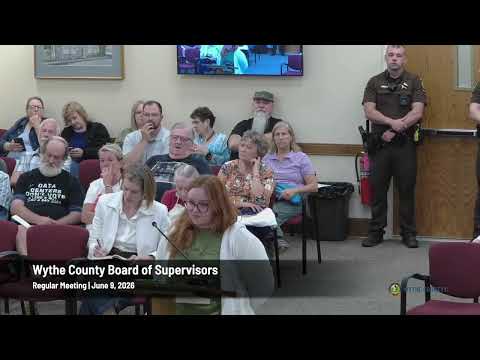
Dozens of residents packed the Wythe County Board of Supervisors meeting on June 9, pressing supervisors to reconsider or limit large data‑center projects and demanding greater transparency from developers.
At citizens time, speakers including Katherine Clemens and Miranda Edwards urged the board to protect the county’s landscapes and resources from what they described as “faceless” hyperscale data centers. “Are you even for our community or are you more concerned with money at this point?” Clemens said, accusing the board of closed‑door meetings and nondisclosure practices. Edwards, who said she holds a master’s in public health, questioned claims that closed‑loop cooling would solve water and energy demands and said a petition opposing data centers had gathered more than 1,300 verified signatures in days.
Fluid Stack, which recently purchased the Solless Arcs project at Progress Park, introduced company representative Kate Franco and described the project’s operations and mitigation plans. Franco said Fluid Stack will not require NDAs, wants to post project information publicly and will construct contractual and permit‑level commitments. She explained closed‑loop cooling and said average daily operational water use “becomes approximately equal to that of seven or so average homes” while describing expected infrastructure upgrades and an eventual local hiring plan; the company estimated 200–500 employees at full campus build‑out.
Citizens pressed Fluid Stack on water, noise and potential hazardous leaks; Franco responded the company will fund required infrastructure upgrades, comply with noise limits and follow all permits and audits. County staff emphasized that the estoppel statement approved by the board only confirms that, at present, the Progress Park parcel is in compliance with recorded Progress Park covenants — it does not substitute for the forthcoming site plan and permitting process. County counsel and staff repeatedly said a site plan remains required and that the board retains the ability to deny building permits if a site plan does not meet standards.
The day’s vote approved the estoppel statement confirming current covenant compliance and urged Fluid Stack to return with the formal site plan for public review and board approval. Several supervisors signaled support for Progress Park’s designation for industrial uses but expressed concern about a separate, unsolicited proposal for roughly 1,000 acres near Exit 86; multiple supervisors urged faster adoption of a land use ordinance and more public engagement to give residents clearer protections and choices.
The board also instructed staff to convene a small task force and hold community town halls and joint sessions with the school board to plan how any future data‑center revenue could be used for capital projects and community needs.
What’s next: Fluid Stack must submit the required site plan and permits; the public and board will have an opportunity to review and vote on those documents. The board’s planning commission scheduled a zoning work session for June 22 to review public input on land‑use changes.