Get Full Government Meeting Transcripts, Videos, & Alerts Forever!
Get email alerts on the Sdge Updates topic
No spam. Unsubscribe anytime.
SDG&E says data fixes and QA/QC cut map segments showing 'zero' hosting capacity
Summary
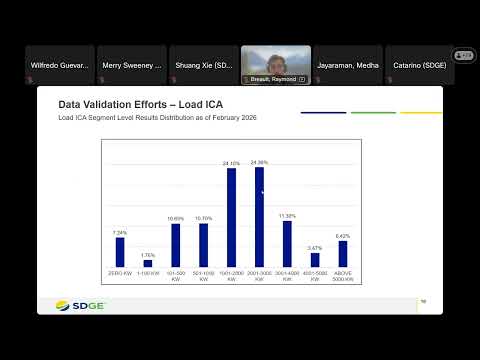
San Diego Gas & Electric told the CPUC quarterly ICA workshop it reduced the share of distribution segments flagged with zero load hosting capacity through model QA/QC and data‑source fixes; stakeholders pressed for detailed root‑cause documentation and for peer utilities to share methods.
San Diego Gas & Electric told regulators and stakeholders at the CPUC’s first quarterly 2026 Integration Capacity Analysis workshop that a multi‑year program of data validation and model tuning has sharply reduced the number of distribution line segments shown on the ICA map as having zero load hosting capacity.
"My name is Mary Sweeney. I'm a distribution policy principal at San Diego Gas and Electric," Sweeney said as she opened SDG&E’s presentation and described updates to the utility’s ICA portal. She told the workshop that SDG&E completed many user‑interface and map legend improvements in February and has been focusing on load and generation data validation.
Sweeney and SDG&E engineers said their work — a combination of QA/QC checks on input data, corrections to equipment settings and other model tuning — produced the decrease in segments flagged as zero capacity since 2022. "We've worked diligently to bring that number down to improve and refine the model and make sure that we're only capturing actual zeros," Sweeney said.
Why it matters: ICA maps are intended to be a public screening tool that helps applicants and planners gauge whether a distribution location is likely to host additional solar or storage without engineering review. A high share of zeros can discourage applicants or create unnecessary interconnection work if many zeros are the result of modeling errors rather than true thermal or voltage constraints.
Stakeholder follow‑up and requests: Anthony, a representative of the California Public Advocates Office, asked SDG&E to explain precisely what changes drove the drop and whether the incorporation of load forecasts affected the numbers. SDG&E engineers responded that the incorporation of forecasted load was already in place and had a minor effect; larger reductions came from iterative QA/QC and corrections to data sources and model settings. "It was a long process from 2022 ... we start fine‑tuning those things and that allowed us to get where we are right now," one SDG&E engineer said.
Multiple stakeholders requested greater specificity in future materials. Several asked SDG&E to return with a documented list of the specific fixes (examples of incorrect data sources, settings changes, or automation logic) that produced the biggest reductions, so other utilities can learn and so the commission can better evaluate robustness across territories.
Next steps and context: SDG&E said it will continue to publish biannual reports (the next due July 31, 2026) and to present updated data at future quarterly workshops. The utility also published new quick‑start guides for the ICA portal and said it plans to continue tracking benchmarks for ICA result quality.
Ending: Stakeholders welcomed the improvements but urged SDG&E and the other investor‑owned utilities to document the exact fixes and to share methods so that apparent inter‑utility differences in zero‑capacity reporting can be explained and, where appropriate, harmonized.