Get Full Government Meeting Transcripts, Videos, & Alerts Forever!
Get email alerts on the Budget Mid Biennium topic
No spam. Unsubscribe anytime.
Budget committee reviews mid‑biennial update; approves consent agenda and flags police bond outreach
Summary
Forest Grove’s Budget Committee approved its consent agenda and reviewed a mid‑biennial update on special revenue, equipment, IT and capital funds. Members discussed funding flexibility for facility maintenance, transient lodging tax uses and contingency funding for a proposed police facility bond.
The Forest Grove Budget Committee approved its consent agenda and spent the meeting reviewing a mid‑biennial update of special revenue and capital funds, emphasizing maintenance funding, tourism tax changes and contingency planning for a possible police facility bond.
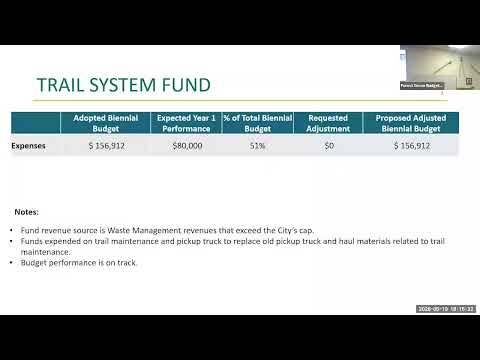
Staff presenter Kimmy Zeler opened the conversation and said, "special revenue funds are funds that account for money from revenue sources that are legally restricted to specific purposes," and walked the committee through each fund’s purpose and current performance. On major maintenance she told the committee that "this year or this biennium about threequarters of a million dollars were budgeted" to address larger repairs, including work at the aquatic center and fire station.
The committee drilled into several operating funds. On building permits, staff said permit fees pay inspection and permit costs; personnel expenses have been below budget because of a retirement and a vacancy, and the budget keeps one inspector slot open to preserve flexibility if permit volume increases. On the transient lodging tax, staff noted the council raised the rate from 2.5% to 3.5% and that recent legislative changes now permit a 50/50 split between tourism promotion and the general fund; staff said Forest Grove’s TLT currently supports four programs including a marketing contract and event sponsorships.
Committee members pressed staff on funding discipline and longer‑term planning for facilities. A member asked how the city decides how much to transfer into the Facility Major Maintenance Fund; staff described a hierarchy used during biennial budget adoption — reserves requirements first, smoothing reserves second, then available savings that may be allocated to major maintenance. On contingency for the planned police facility bond, a committee member said the city should not ‘‘scrimp’’ on communications spending and urged sufficient funding for outreach; staff replied that vacancy savings and contingency are available sources and that any additional request would come to council for approval.
Staff also reviewed the equipment fund and IT investments. Public works staff noted long lead times for specialty vehicles and said the equipment fund has more than $1 million in contracted purchases across the biennium; IT investments this year included new workstations and server upgrades, and staff said an intergovernmental agreement with a new provider is under review to reduce outsourcing costs.
On some discrete items, the committee questioned a compound water meter replacement estimated at $180,000; staff said the high estimate reflects plumbing and access complexities and that final cost is expected to be lower once specifications are finalized.
The committee endorsed sending staff’s recommended adjustments on to council for consideration and closed the budget committee portion of the meeting. Staff will follow up with detailed fund balances and bring items that require council action to an upcoming council meeting.
The committee did not receive any public comments at the start of the meeting and approved the consent agenda (minutes from May 12) by voice vote.