Get Full Government Meeting Transcripts, Videos, & Alerts Forever!
Get email alerts on the Capital Improvements topic
No spam. Unsubscribe anytime.
Eagle Pass planning commission backs five-year CIP after debate over planning-level estimates and bridge costs
Summary
The Planning & Zoning Commission voted to forward the city's proposed five-year Capital Improvement Plan to City Council after staff described priorities and planning-level cost estimates for roughly 30 projects. Commissioners pressed staff about estimate methods, procurement safeguards and the fiscal risk of large bridge projects and bonds.
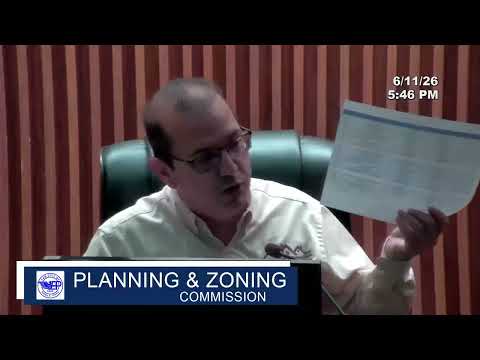
The Eagle Pass Planning and Zoning Commission on June 11 reviewed the city's proposed five-year Capital Improvement Plan and voted to recommend it to City Council following a lengthy presentation and question-and-answer session with finance, engineering and department staff.
Chair Tiffany Vasquez Rodriguez opened the meeting and turned the presentation over to finance staff, who said the CIP lists projects that meet the city's criteria (an estimated cost of $100,000 or a useful life of 10 years or more) and represents planning priorities rather than guaranteed funding. "These are what are typically called planning level estimates," staff said when commissioners pressed for the basis of the figures, adding that detailed engineer estimates cost time and money and are not used for every item unless funding is certain. (Quote attributed to Omar Rodriguez.)
The commission heard a project-by-project review of roughly 30 proposals. Major items included a $2.5 million custom 100-foot aerial apparatus for the fire department to replace a 2007/2008 Pierce ladder truck that staff said is nearing end of service life and cannot safely reach some building heights; a $3.4 million animal control shelter; a $15 million aquatic center renovation; multiple drainage projects ranging from several hundred thousand dollars to an approximately $40 million regional Main Royal project; a proposed $3 million multimodal transportation hub; and two bridge projects—a $23 million realignment and a $50 million expansion for the Camino Royale (Bridge 2) port of entry.
Ports-of-entry manager Patricia Mancha described the Bridge 2 expansion as an 18-month project intended to double capacity (from six lanes to 12), add a parallel structure to avoid service interruptions, separate pedestrian and commercial flows and create a central operations zone for U.S. Customs and Border Protection. "My name is Patricia Mancha. I am in charge of the ports of entry for the city of Eagle Pass," she said while outlining operational benefits and CBP coordination. (Quote attributed to Patricia Mancha.)
Several commissioners expressed concern about how planning-level numbers are derived and whether publicizing large, preliminary figures could be misleading or exploited by bidders. One commissioner summarized the caution: "I'm not against any of these projects ... I'm just questioning the $15 million" aquatic center and asked for stronger cost certainty and the possibility of hiring an outside project manager. (Quote attributed to Committee member.) Staff replied that Texas purchasing rules require public bidding and that competitive procurement helps protect taxpayers, and that council could authorize additional spending for detailed estimates if it chose.
Commissioners also flagged fiscal risk tied to financing. A member noted the CIP total rose from roughly $150 million last year to about $181 million in the current presentation and asked how the city would manage potential bond payments, particularly given concurrent port-of-entry projects and the possibility of additional regional bridges. Staff estimated bond service could be in the range of $5 million to $6.5 million annually for a $75 million project and said those financing decisions would be made later at council with full fiscal analysis.
The commission asked for and received clarifications on individual items: the police department explained that the new safety headquarters unfinished area would be built out for offices; engineering staff outlined that drainage projects aim to reduce flooding from a large mixed-use watershed and that a regional detention pond and master plan are intended to coordinate multiple improvements; and parks staff described tradeoffs between developer-dedicated parkland versus fee-in-lieu and the substantial additional cost to convert raw land into developed park amenities.
After the presentation and discussion, the commission entertained a motion to approve the CIP recommendation "as is," the motion received a second, and the chair called for the vote; the item was moved forward to City Council in the meeting's recorded actions. The meeting then adjourned.
What comes next: The Planning & Zoning Commission's recommendation will go to City Council, which will review rankings, funding sources and potential financing options (including bonds and grants) before adoption or modification. Several commissioners asked staff to return with options for more precise estimates or an item to consider hiring a project manager to improve cost certainty.
Sources: Eagle Pass Planning & Zoning Commission meeting transcript, June 11, 2026.