Get Full Government Meeting Transcripts, Videos, & Alerts Forever!
Get email alerts on the Zoning Code Amendment topic
No spam. Unsubscribe anytime.
Anchorage zoning board postpones proposed Title 21 change after members seek more data and legal review
Summary
The Zoning Board of Examiners and Appeals postponed consideration of a draft Title 21 text amendment that would raise the minor‑modification threshold and tweak review criteria, asking staff for data on encroachment frequency, fee impacts, and legal guidance before moving forward.
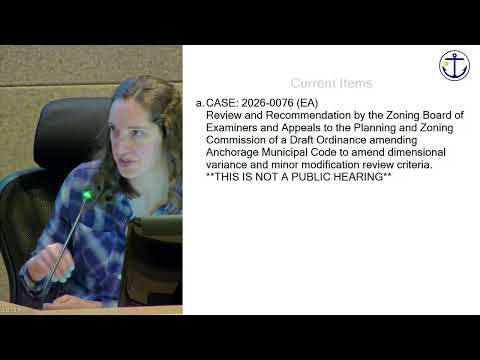
The Municipality of Anchorage Zoning Board of Examiners and Appeals on June 11 postponed consideration of case 2026-0076, a staff‑drafted text amendment to Title 21 that would raise the administrative threshold for minor modifications and revise several review criteria.
Staff introduced the early draft, saying it “amend[s] Title 21 to make a text amendment” and that the proposal “increases the threshold for minor modifications” so that a larger set of encroachments could be resolved administratively rather than through a public hearing. Staff emphasized the draft was preliminary, had not completed legal or agency review, and was before the board to solicit feedback rather than for final action.
Board members pressed staff for evidence supporting the proposed change. Several members asked whether the 10 percent threshold in the draft was based on data or was simply a workable estimate; one commissioner said 20 percent might be more defensible in practice and another proposed a hybrid approach (percentage or a fixed minimum, for example one foot). Staff responded that building‑permit reviews often catch encroachments and committed to returning with hard data on the distribution and frequency of encroachments and how many cases the department approves administratively versus those that require a hearing.
Commissioners also raised practical and equity questions. Members asked about the cost difference for homeowners between seeking an administrative minor modification and pursuing a public‑hearing variance; staff reported current fees include a $135 minor‑modification fee, a roughly $270 nonconforming‑determination fee plus about $50 recording fee, and a $710 public‑hearing variance fee (staff said larger or more complex cases can incur higher fees, up to roughly a few thousand dollars). Several members asked staff to present fees and economic impacts in future materials.
The draft also proposed tweaks to three of the existing eight variance review criteria, including language on placement of structures and an ADA/accessibility criterion. Members questioned whether some criteria — notably a clause limiting relief for hardships that are “self‑imposed” and a reference to “neighborhood character” — were vague or susceptible to inconsistent application. On ADA applicability, some members argued the criterion can apply variably to residences (different levels of accessibility can be relevant) and asked whether the board could instead record a finding that a criterion “does not apply” in particular cases. Staff agreed these interpretive questions warrant legal review.
After extended discussion in a committee‑of‑the‑whole format, a motion to postpone the case to a date uncertain passed; board members asked staff to return with (1) data on the size and frequency of encroachments, (2) clear fee tables showing homeowner costs under each pathway, and (3) legal guidance on how the code and the board’s findings interact (for example, whether the board may find a criterion does not apply). Staff indicated the draft could proceed to Planning and Zoning Commission and then the Assembly later in the process once revised.
The board did not take a final vote on any code changes; staff described the June discussion as early, advisory feedback and said formal public hearings would occur later in the Planning and Zoning and Assembly processes.