Get Full Government Meeting Transcripts, Videos, & Alerts Forever!
Get email alerts on the Tech Usage topic
No spam. Unsubscribe anytime.
Mosinee board reviews tech-usage data, asks staff to draft flexible screen-time policy
Summary
The Mosinee School District board heard device-usage data showing school-day Chromebook averages of about 1.6 hours and discussed a draft tech-usage plan recommending grade-specific screen-time guidance, parental controls and ADA and data-privacy safeguards; staff will draft policy language and return for further review.
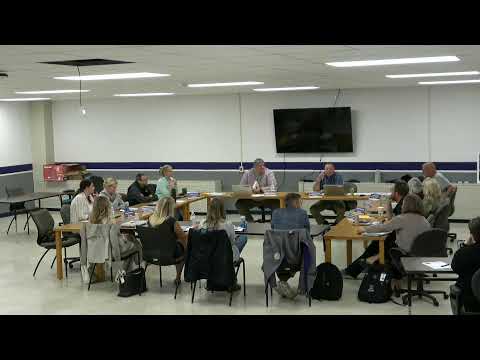
The Mosinee School District Board on — heard staff present device-usage data and a proposed framework for a technology-usage policy that would set grade‑band guidance, tighten vetting for classroom apps and expand parent-facing supports.
Christie, the staff member presenting the Reveal usage report, told the board the district’s monitoring window covered the school day “from 7:30 to 3:15,” and that aggregated device data show roughly 1.6 hours per school day on average districtwide — about 1.2 hours in elementary grades, 1.63 in middle school and about 1.85 in high school. Christie and Tom cautioned that the figures measure when a screen is on and that state online testing and legitimate curriculum tasks can raise averages.
Board members pressed staff on distinctions between active, instructional device use and passive screen time. Tom described the district’s vetting process for classroom apps: staff review privacy policies and alignment to curriculum standards and avoid programs that rely on reward-driven or “gamified” engagement that staff said can encourage noninstructional use. “We run through all the data security,” Tom said, describing checks performed before teachers use a new platform.
Staff proposed illustrative limits aimed at protecting core instruction time: younger elementary teams reported using technology in short instructional bursts (K–1 around 30–40 minutes on many days), and staff suggested a K–3 daily cap in the neighborhood of one hour with clear exceptions for technology class and state testing. For lower grade academic blocks, staff recommended no more than about 20 minutes of device time per subject to preserve a 60‑minute core instructional window.
The board also discussed enforcement and family supports. Staff described a three-tier filtering system (green/yellow/red), and said parents can use a Securely Home app to apply restrictions when devices are used outside the school day. Staff reported they receive realtime alerts for certain hazardous searches and that principals or specialists may request individual students be placed on stricter filters.
Several members urged the district to provide additional parent training (for example at open houses or parent‑teacher events) so families know how to use parental controls and the district’s monitoring tools. The board asked staff to draft policy language that preserves teacher discretion, allows grade‑specific exceptions and explicitly addresses ADA and IEP considerations. The item will return to the board for further review; staff said they will bring more grade‑level data and clearer draft wording in a future meeting.
Votes and next steps: the board asked staff to proceed with drafting formal policy language and to return with a draft and additional data at a subsequent meeting.