Get Full Government Meeting Transcripts, Videos, & Alerts Forever!
Get email alerts on the Streaming Tax topic
No spam. Unsubscribe anytime.
Sleepy Hollow finance committee backs review of 5% amusement (streaming) tax to recoup lost franchise fees
Summary
The Sleepy Hollow Finance Committee voted June 11 to ask the village board to pursue legal review of a proposed 5% amusement tax on streaming services intended to make up for falling TV franchise fees; staff cited outside examples that produced six-figure revenue but said local revenue is uncertain and requires attorney review.
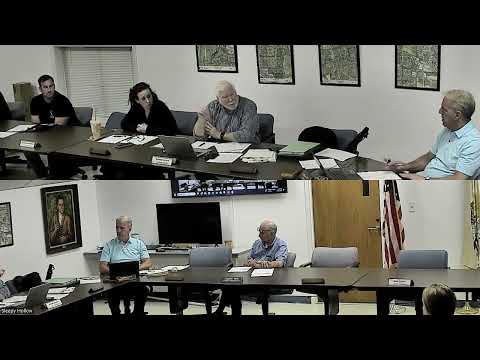
The Sleepy Hollow Finance Committee on June 11 voted to ask the village board to pursue legal review of a proposed amusement tax that would charge streaming services a percentage of monthly customer charges to capture revenue lost as residents cut traditional cable and pay for internet-based video services.
Committee members discussed examples from nearby municipalities where a 5% charge on streaming services produced meaningful revenue. The presenter identified a Compton Hills implementation that generated about $200,000 in its first year; committee members noted Compton Hills has a larger population than Sleepy Hollow and said that figure should be treated as comparative rather than predictive for Sleepy Hollow.
The committee’s discussion covered how the tax would work: the village would adopt an ordinance, notify streaming vendors and require them to collect the tax from customers within Sleepy Hollow (ZIP discussed as 60118), and provide a monthly remittance form. Staff said some communities hire outside managers to administer the tax; committee members emphasized preference to keep administration municipal unless workload compelled contracting.
Members also reviewed how the village currently receives franchise and utility-related fees. Staff reported franchise revenues tied to TV services have declined (examples cited by staff showed franchise revenues falling from highs around $59,000 in earlier years to roughly $35,000 in the most recent fiscal year), and local-use-tax receipts varied year to year. The amusement/streaming tax was presented specifically as a potential offset to those declines.
On the motion before the committee, members voted to recommend that the board authorize legal review and follow-up analysis. The committee directed staff to forward the draft ordinance to the village attorney, Mark Schuster, for an opinion on whether the village — as a non-home-rule municipality — may move forward with an amusement tax for streaming services and on the draft ordinance’s form and administration requirements.
Next steps: the committee’s action was a recommendation to the board, not an adoption of a tax. The board must decide whether to authorize legal review and then whether to place an ordinance or a referendum before voters if required. If the board directs further work, staff indicated additional analysis would include local household counts, projected revenue modeling, and administrative cost estimates.