Get Full Government Meeting Transcripts, Videos, & Alerts Forever!
Get email alerts on the Supportive Housing Women topic
No spam. Unsubscribe anytime.
Douglas County officials review network model to expand supportive housing for women
Summary
County staff and local providers presented a coordinated “network” approach to increase supportive housing and wraparound services for women in Douglas County, emphasizing shortages of sober living and childcare, funding strategies, and lessons from Amethyst Place in Kansas City.
Douglas County commissioners received a briefing June 10 on a proposed network to expand supportive housing and wraparound services for women, one element of the county’s “A Place for Everyone” strategy to reduce chronic homelessness.
Jill Jolliker opened the presentation by telling the commission the project’s goal: “we're here today to present … supportive housing for women in Douglas County and a network approach to maximizing resources and coordinating care,” and she asked for feedback on a model that pairs housing providers with stabilization and therapeutic partners. The network would knit together providers such as Cardinal Housing Network, DECA, Family Promise and therapeutic partners including STA Care Center.
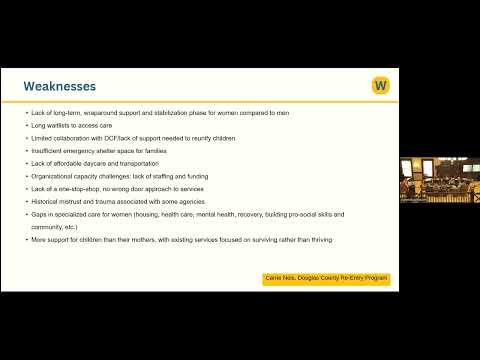
The presenters used a SWOT analysis and a theory-of-change framework to describe why the effort focuses on women. Carrie Nice, re‑entry director at the Douglas County jail, said the county faces both a shortage of units and a shortage of long‑term, wraparound services for women exiting custody. “If they live there 45 days, we touch them 45 times,” she said of case-management contacts at one pilot housing site, arguing that daily touchpoints are not the same as the sustained supports needed to keep people housed and healthy.
Capacity examples cited during the briefing included three Cardinal apartments at 1128 Ohio (all occupied), DECA’s transitional campus units (roughly 9–10 originally planned, described as closer to eight or nine in practice), and five Oxford House units in the county, two of which are configured for mothers with children — roughly 15 beds in those specific programs. Hannah Bolton of Cardinal Housing Network described Cardinal as a more-structured option with a house manager and more intensive case management, while the Oxford House model was described as lower-structure, peer-led housing.
Panelists and commissioners emphasized that accurate counts require coordinated-entry and HMIS data. Presenters recommended using coordinated entry and the county dashboard to measure inflows and outflows and to compare current capacity with the 2022 needs assessment baseline. Jill Jolliker said those tools help track whether more people are moving into stable housing and fewer are entering homelessness.
Speakers highlighted disparities in who is experiencing homelessness. Zach from STA Care Center cited shelter data showing higher representation of Native/Indigenous people among recent shelter guests than in the county population: “almost 10% of new guests were Native American or Indigenous folks” in recent shelter intake data, while the local Indigenous population is under 2% in the county, a gap presenters described as a signal to prioritize culturally informed outreach and partnerships.
Panelists discussed program design choices that affect stabilization. Sarah Nafomalong, from Amethyst Place (a Kansas City program the group is studying as a model), said Amethyst uses a two‑generation approach and requires participants to live in a substance‑free environment to protect community safety; she also noted Amethyst’s practice of subsidizing early months of housing so residents can stabilize before rent obligations begin. “At Amethyst Place, they don't pay rent for the first six months,” she said, describing state voucher support that helps residents establish safety and engage in treatment.
By contrast, Cardinal’s current structure asks residents to begin paying rent after 30 days; presenters said that shorter rent-free windows make it harder for residents to save and transition into independent housing. Panelists discussed options to bridge that gap, including flexible vouchers and donor-funded subsidies.
Funding and scaling strategies were a major topic. Presenters urged diversified revenue — a mix of county-administered grants, state vouchers, private donors and creative approaches such as master-leasing buildings to place residents quickly. Jill and others suggested the county could play a backbone role in administering braided grants and flex vouchers while partners with grant management capacity (like DECA or the housing authority) could be the formal applicants for complex federal or state funding.
Workforce and peer supports also featured prominently. DECA and other partners urged developing a peer workforce (hiring former program participants as staff) and training pipelines for case managers, recovery coaches and behavioral-health providers to sustain expanded services.
Commissioners asked for clearer, shorter-term metrics and for specific next steps; presenters recommended more precise counts via coordinated entry and HMIS and additional follow-up to identify opportunities for collective grant applications. The briefing closed with the commission recessed until the 5:30 p.m. business meeting.
The presentation left commissioners with two practical takeaways: (1) the county and partner organizations have increased unit capacity since 2022 but still lack enough housing and long-term supports for women; and (2) scaling will require coordinated data, diversified funding (including county administration of braided grants), and operational decisions about rent timing and childcare that affect participants’ ability to stabilize.
What happens next: staff and partners said they will follow up with coordinated-entry/HMIS data, specific unit counts, and recommendations for funding and operational approaches to support the network model. The work session did not include any motions or votes.