Get Full Government Meeting Transcripts, Videos, & Alerts Forever!
Get email alerts on the Attendance topic
No spam. Unsubscribe anytime.
Portland schools report modest attendance gains, fall short of one‑year target; staff outline multi‑year plan
Summary
At a June 11 committee meeting, district staff said overall attendance rose about 1.4 percentage points in year one of the DCIP but missed a five‑point one‑year target; staff outlined multi‑year targets, credited Jefferson High’s leaders for a 7‑point gain and said targetted work is needed for Pacific Islander and other focal groups.
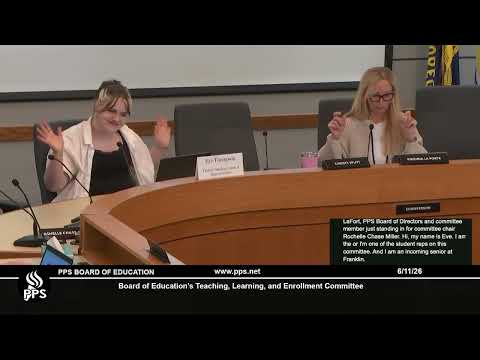
The Portland Public Schools Teaching, Learning and Enrollment Committee heard a quarter‑four report on the district continuous improvement plan on June 11, with staff framing attendance as a core lever connected to district goals on belonging, literacy and math.
Dr. Jill Bryant, who led the attendance update, said the district served roughly 44,000 students and recorded a 1.4 percentage‑point increase in overall attendance this year — progress staff described as meaningful but short of the 5‑percentage‑point increase the district set as a one‑year goal. "It was a lofty goal of increasing this year five percentage points," Dr. Bryant said, noting the work is year one of a multi‑year plan.
Staff emphasized that the district has reset growth targets to span multiple years: instead of a single five‑point jump, planners are now framing a roughly six‑point improvement over three years (about two points per year). District leaders said the rolling approach is intended to create steadier, realistic gains tied to school‑level implementation and family engagement.
The presentation called out several positive signs. Dr. Bryant credited Marquita Guzman and school leaders for student outreach efforts and highlighted Jefferson High School, where leadership attributed a more than seven‑percentage‑point attendance improvement to targeted outreach and an on‑site attendance coach. Jefferson’s improvement was singled out as the largest school‑level gain in the district this year.
At the same time, staff flagged subgroups that require targeted approaches. PACIFIC ISLANDER students — a small but high‑variance group in the data — showed declines that staff said will be addressed through deeper root‑cause analysis and culturally responsive family engagement. "With a few students the percentage is a substantial percentage and we'll be working closely with FACE to determine our targeted response," staff told the committee.
The committee also discussed how the state and district define some measures differently. Staff warned that the state’s attendance and 9th‑grade on‑track formulas can differ from the district’s internal metrics; staff argued the district’s stricter definitions (used for internal planning) better predict longer‑term outcomes.
Board members and student representative Eve Thompson pressed staff on how family and community engagement (FACE) is integrated with professional learning, and whether the state provides funds for attendance improvement. Staff said the state offers technical assistance and data support but not additional staff or direct funding for local attendance efforts.
Staff outlined next steps: deepen culturally responsive communications with families, strengthen data literacy among school attendance teams so they can build more effective interventions, and continue systemwide investments in tier‑one climate and two‑way family partnerships.
The committee closed with requests for follow‑up: board members asked staff to provide further subgroup breakdowns (including white student baselines and comparisons) and historical context so the board can track trends over multiple years.