Get Full Government Meeting Transcripts, Videos, & Alerts Forever!
Get email alerts on the Wind Energy Compliance topic
No spam. Unsubscribe anytime.
Marion County weighs enforcement steps as wind farm lighting, noise and interference complaints persist
Summary
Commissioners spent a multi-hour session reviewing wind-energy permits for the Sunflower Energy Center, hearing staff say modeled pre-construction noise results were within permit limits but residents continue to report noise, aircraft‑detection lighting (ADLS) reliability problems and occasional radio/TV interference. County counsel outlined remedies including notice of noncompliance, fines and possible court action; staff will draft enforcement language.
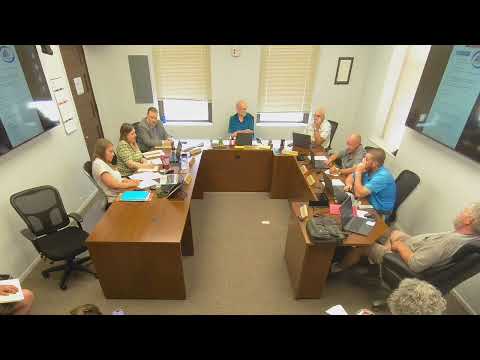
Marion County commissioners devoted more than an hour on June 8 to persistent complaints about operations at the Sunflower Energy Center and other wind facilities, focusing on three recurring issues: noise, aircraft‑detection lighting systems (ADLS), and interference with communications.
Planning staff summarized the regulatory framework that governs these projects, noting the county’s zoning rules and the specific terms of the project’s conditional‑use permit and comprehensive development agreement (CUP 2019‑11 and resolution 2019‑21). Those rules require modeled and measured sound levels not to exceed 55 dBA at non‑participating property lines and 50 dBA at non‑participating residences; staff said the pre‑construction sound studies modeled maximum receptor values around 49.3 dBA and a maximum property‑line projection near 54.8 dBA.
Commissioners and residents, however, said post‑construction experiences sometimes differ from modeling. Planning staff and the sheriff’s office have investigated spot complaints and, in those instances, reported the company’s onsite measurements as showing compliance. Commissioners asked for the county to take the lead collecting complaints and investigating them — rather than requiring residents to contact the company directly — and to maintain a public record of investigations.
County counsel outlined the practical enforcement path: if staff determines a violation has occurred, counsel can issue a formal letter of noncompliance with a specified cure period (for example, 30–60 days). If the company does not reasonably cure the violation, remedies identified in county code and the project agreement include administrative fines and, if necessary, judicial options such as injunctions or mandamus actions. Counsel warned that revoking a CUP requires re‑running the same public‑hearing process that approved it initially and that litigation can be costly and contested; he recommended graduated steps beginning with written notice.
ADLS lighting — the systems designed to reduce steady nighttime tower lights by blinking lights only when aircraft are detected — drew the strongest push from several commissioners and residents. Staff and counsel acknowledged ongoing reliability problems with ADLS equipment: some towers report lights that remain on or lamps that appear non‑functional. Commissioners asked staff to prepare a firm enforcement letter that would give the developer a clear deadline to restore functional ADLS systems and warned that escalating to fines or a court motion could follow if compliance is not achieved.
The board also discussed communication and radio/TV interference. Staff said the project’s permitting included AM/FM analysis and Fresnel‑zone checks for microwave links; the developer supplied a parent‑company guarantee for potential mitigation costs. Planning staff said mitigation options include optimizing nearby base stations, installing repeaters or using meteorological towers as repeater platforms if needed.
County staff and counsel agreed to draft a proposed notice of violation and enforcement language for the board to consider next week, and to compile the historical complaint and post‑construction measurement records from the developer and any third‑party sound studies. The discussion made clear the commissioners want the county to own the complaint intake and verification process, provide timely reports to the public, and have a concrete escalation path if problems persist.