Get Full Government Meeting Transcripts, Videos, & Alerts Forever!
Get email alerts on the Policy Updates topic
No spam. Unsubscribe anytime.
Saint Croix Falls board reviews new staff‑communication and bus surveillance policies tied to state law
Summary
District staff presented two policy drafts required by recent Wisconsin legislation: one formalizing staff-student communication expectations and training, and another clarifying video/audio monitoring (including buses), notification and record-retention practices. No final vote was taken on the policies.
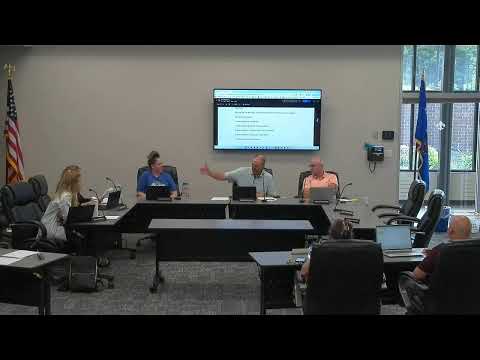
A district staff member told the Saint Croix Falls School District board on June 10 that two policy drafts — one on staff communications with students and another on security cameras and electronic monitoring, including on school buses — are being advanced to ensure compliance with recently enacted Wisconsin law.
The staff presenter said the communication policy (draft 528.1) is based on Wisconsin Association of School Boards (WASB) templates and "has to outline what the potential consequences are for uh violating the policy which of course is, you know, discipline up to and including termination." The presenter emphasized the draft is intended to formalize existing expectations rather than change routine practice: "I don't see this as being any sort of change in behavior for any staff member. Right?" the presenter said.
Why it matters: the draft requires explicit notice to staff and students, mandatory training (the presenter said the Wisconsin Department of Public Instruction is developing required training), and handbook updates. The presenter said training and handbook references will be incorporated into opening in‑service activities and existing recordkeeping routines.
The board discussed common, practical examples. A trustee asked whether a coach texting to cancel a game would be covered; the presenter replied that such short, emergency messages remain acceptable and noted district staff have encouraged use of district-approved apps (the presenter mentioned "Sports U" as an example) for accountability but would not penalize reasonable, time-sensitive communications. The presenter said the policy "doesn't preclude folks from communicating" in crisis circumstances and that approved methods are recommended chiefly for recordkeeping and protection of staff.
The surveillance draft (policy 731.3) was presented as a standalone policy to cover cameras across district facilities and to incorporate recent statutory language permitting audio or video recording on school buses. The presenter said the district already uses cameras in many facilities and that the new policy provides "clarity" about bus recording, notification requirements (postings on buses and informing parents) and access rules. The presenter said parents may view video related to their child but generally cannot take copies; copies may be produced only under legal process (for example, subpoena or court order) because footage can include other students.
Retention and access: the presenter described uncertainty about a legally mandated retention period and said retention decisions will be driven by capacity and cost; when asked, the presenter said the district currently keeps roughly two weeks of routine footage in many locations but will retain recordings longer when they become part of an investigation (at which point they are handled as student records and follow different retention schedules). The presenter also noted that some bus cameras may overwrite footage faster because of storage limits.
What the board did: the policies were presented for review and discussion; there was no formal vote on the policy drafts during the session. The presenter said the policies, once finalized, will be incorporated into the staff handbook and that administrators will discuss them at opening staff meetings.
Public‑records context and next steps: the presenter noted that footage used in an investigation becomes a student record and is subject to applicable privacy rules. The district will post required notices on buses and include the policy language or a link in opening‑year communications to families. Further drafting and administrative review with principals was expected before returning the policy for formal consideration.
Representative quotes from the meeting: "I don't see this as being any sort of change in behavior for any staff member. Right?" — a district staff member presenting the policies. "It has to outline what the potential consequences are for uh violating the policy which of course is, you know, discipline up to and including termination." — a district staff member.
The board did not vote on the policy drafts at the June 10 meeting; staff said the drafts will be refined and returned for approval at a future meeting.