Get Full Government Meeting Transcripts, Videos, & Alerts Forever!
Get email alerts on the School Reconfiguration topic
No spam. Unsubscribe anytime.
South Vermillion officials weigh renovating elementaries or consolidating to one campus
Summary
District officials presented two options—renovate existing elementary schools or consolidate elementary grades onto a single campus—outlining enrollment declines, cost estimates, bond timing tied to April 2028, potential staffing efficiencies, and community concerns about traffic and safety. A follow‑up meeting is scheduled for June 24 and materials will be posted online.
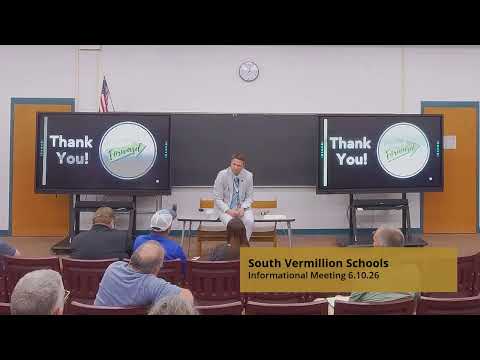
Dr. Williams, presenting for South Vermillion Com Sch Corp, outlined two options at an informational session: renovate the district’s elementary buildings or consolidate elementary grades onto one campus and reconfigure the remaining buildings for 7–12 instruction. He said the district expects bond capacity to open in April 2028, enabling capital work “without raising any taxpayer money.”
The presentation cited a long‑term enrollment decline that Dr. Williams said reduced total enrollment from about 1,707 in 2017–18 to about 1,423 at the most recent school‑year close, a drop of roughly 284 students. He said certified classroom staff decreased modestly (from 116 to 108), which improved student–teacher ratios but strained finances because state funding (ADM) follows students.
Dr. Williams reviewed how the district budgets operate: the education fund (state ADM dollars) pays instruction and curriculum; the debt‑service fund (local property taxes and other levies) covers bonds and leases; and the operations fund (local property taxes) pays salaries, utilities and maintenance. He noted a recent unplanned chiller replacement at the middle school that cost about $550,000 as an example of capital risks that inform timing.
Cost estimates presented to the audience included roughly $10 million to renovate Central Elementary (major plumbing and mechanical work), $6–8 million for Van Dyne renovations, and an addition‑style option for one campus that Dr. Williams estimated at about $5 million to add seven‑to‑eight classrooms to the middle/high school complex. He said the district could issue up to $25 million in bonds but would likely target $21–22 million and spend about $20–21 million after issuance costs.
Dr. Williams argued consolidation could preserve or expand programming—reintroducing elementary art, extending high‑ability programming, expanding extracurriculars and easing deployment of special‑education staff and counselors because more services would be co‑located. He stressed that, under the plan described, the district would not eliminate positions as a direct consequence of reconfiguration and would seek efficiencies over time through retirements and non‑replacements.
A frequent theme in the presentation was facilities capacity: the middle school’s 40 classrooms were shown with capacity for about 800 students (current enrollment ~476), the high school 48 classrooms with capacity ~950 (current enrollment ~386), and districtwide utilization roughly 53 percent. Dr. Williams suggested a K–6 building on the middle school campus and a 7–12 building across the parking lot could move the district closer to an efficient occupancy level.
A resident commenter, Neil, pressed the district on traffic and safety at the major intersection near campus, arguing local roads and the highway approach are inadequate for larger sustained traffic volumes and urging the district to engage INDOT and state representatives for intersection reconstruction rather than relying on signal requests alone. "It's a matter of time before disaster strikes," Neil said; Dr. Williams acknowledged the concern and said the district would continue conversations with INDOT and local officials.
Dr. Williams said the district will post the reconfiguration materials and financial information on a public web page (going live the next day), will open a general email address for public questions, and will hold a follow‑up community session on June 24 to collect feedback and update the FAQ. The session closed after Mr. Ream asked for a motion to adjourn and a board member called Bruce moved/seconded to adjourn; the transcript records the motion but does not include a recorded roll‑call or tally.
Next procedural steps identified by the district: finalize planning and design timelines (Dr. Williams estimated nine months for planning/design and three months for bidding), decide whether to pursue bond issuance by April 2028 to preserve current tax rate capacity, continue outreach with parents, staff and the community, and address traffic/INDOT engagement in parallel with facility planning.