Get Full Government Meeting Transcripts, Videos, & Alerts Forever!
Get email alerts on the Budget topic
No spam. Unsubscribe anytime.
Residents urge equity and clearer change tracking at FY2027 budget hearing; council considers CARES funding reallocation and authorizes CARES to form 501(c)(3)
Summary
At the first public hearing on the FY2027 budget, residents urged stronger equity metrics and transparent change tracking; the city manager warned of higher health‑insurance costs and looming WMATA reimbursement deadlines. Councilmember Pompey proposed a $150,000 CARES reallocation for community health programs and the council authorized CARES staff to pursue a 501(c)(3) for fundraising.
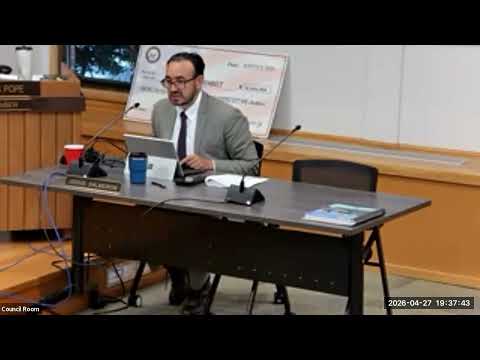
Greenbelt held the first of two required public hearings on the proposed FY2027 budget and heard multiple residents press the council to translate DEI goals into measurable departmental actions and to make work‑session changes more accessible to the public.
Resident Bob Rand praised staff’s budget presentation but urged more explicit departmental metrics and data collection to make equity a measurable part of the FY2027 plan. “With a few exceptions, I don't see this forward thinking on equity reflected in the departmental issues and services section,” Rand said, urging that national disparities are likely mirrored locally and should be addressed in departmental planning.
Another resident, Mr. Orleans, requested that staff provide a table of changes from the draft budget at each work session so residents can easily see modifications between versions. City Manager Josue Samaron responded that the budget web page includes a dedicated budget page with documents, summaries, and session‑specific Q&As, and said staff would continue to refine accessibility and Q&A postings.
On administrative pressures, the city manager warned that healthcare and prescription plan renewal costs came in substantially above budget assumptions — an insurer renewal in the packet showed a near‑10% increase that staff negotiated down to under 10%, leaving roughly a 4% overrun the city must address in final budget adjustments. He also noted a June 30 deadline to submit reimbursements for a WMATA bond bill tied to some projects.
Separately, Councilmember Pompey proposed a one‑year funding reallocation to sustain CARES community health programs (initially estimated at $150,000, reduced to $130,000 after an anticipated $20,000 apprenticeship offset) and identified possible offsets including pausing a DEI position, reducing council professional services, and adjusting special programs and capital line items. Pompey asked that the proposal be included on the final budget reconciliation sheet for council consideration.
Council also voted to allow CARES staff to pursue formation of a 501(c)(3) so the unit can access foundation and corporate funding avenues that are not otherwise available to municipal departments. The motion to authorize staff to form the nonprofit carried by voice vote; council later created a topical council working group (Pompey, McKinney, Mayor Pro Tem Weaver) to support that formation process after a separate vote that passed 5–2.
City staff and members emphasized that some senior services (for example, Green Ridge House services funded by a Department of Aging grant) are funded separately and are not slated to end; the CARES nursing/community health programs supported by ARPA funds require short‑term continuity planning. Councilmembers and staff said one‑time budget offsets are the preferred approach if the CARES request is approved for a single additional year.