Get Full Government Meeting Transcripts, Videos, & Alerts Forever!
Get email alerts on the Policy Updates topic
No spam. Unsubscribe anytime.
Board moves updated academic standards, transportation and nonresident eligibility policies to next week
Summary
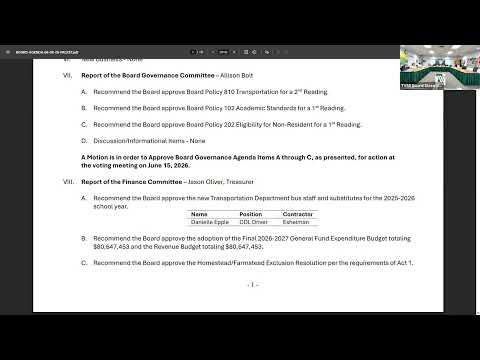
The Twin Valley board advanced Policy A10 (transportation), Policy 102 (academic standards updated to match state standards) and Policy 202 (nonresident eligibility with added citation) to next week's agenda for formal approval; board members asked for curricular clarifications.
At its June 8 meeting the Twin Valley School District board voted to move several governance and instructional policies to next week’s agenda for final action, including Policy A10 (transportation), Policy 102 (Academic Standards) and Policy 202 (Eligibility for Nonresident Students).
Staff said Policy A10 contained no substantive changes and presented Policy 102 as a mandated update to reflect state standards for science, environment/ecology, technology and engineering across specified grade bands. The staff presentation noted where the changes appear in the policy document. A board member asked for clarification on how personal finance, music and world language map into the new banding; staff described K–12 sequencing for personal finance (K–2, 3–5, a course embedded at grade 6 and two high‑school courses required for graduation) and confirmed music falls under arts and humanities.
Policy 202 was presented as updated for state compliance and to include language on disenrollment of nonresident students; staff read an added citation in the policy as "24P s 11 11 84 regarding military parents and student support" during the presentation and said the changes are on page 2 of the draft. Board members asked who would follow up on procedural questions; staff said current responsibilities fall to administration.
Board action and next steps: motions to move each policy to next week’s agenda were made and passed by voice vote or roll call as noted at the meeting. Staff agreed to provide a short summary or board letter explaining specific curricular details and to share the staff survey results used in the instructional-technology decisions when those items return to the agenda.
The board’s requests for additional information included explicit asks for: a short board letter on personal finance requirements at the high‑school level, the staff survey that supported the data/system selection, and clearer cost information for dual‑enrollment options.