Get Full Government Meeting Transcripts, Videos, & Alerts Forever!
Get email alerts on the Middle Housing topic
No spam. Unsubscribe anytime.
Regional planners say "transit community middle housing" applies even without transit; towns urged to clarify local rules
Summary
Presenters told commissioners the statute pulls a definition from transit-oriented development language but the middle-housing requirement in section 16 applies broadly; staff urged towns to adopt clear, nondiscretionary standards before July 1 and consult legal counsel about implementation and parking rules.
Caitlyn, a presenter for Crag, told commissioners the statutedoes not limit "transit community middle housing" to areas served by transit: the law points to a definition in a different section but the requirement in section 16 can apply even in places without bus or rail service. "You don't have to have transit in your community to be required to do this middle housing piece," she said, noting the cross-reference has sown confusion among local boards and residents.
Why it matters: The cross-reference means towns that thought the rule only applied to transit-oriented districts may still get applications for middle-housing in ordinary commercial or mixed-use zones. Caitlyn recommended that municipalities treat the term as "middle housing" in local regulations and cite the statutory source to reduce confusion when presenting amendments to commissions.
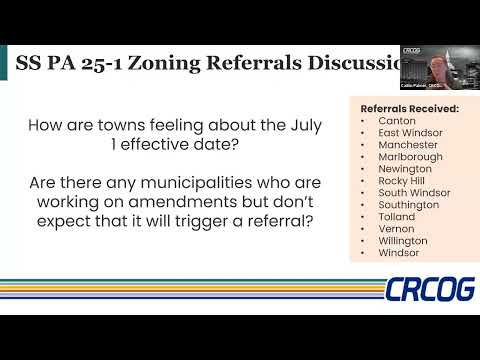
Commissioners raised practical concerns about timing and enforceability when a developer files before a town has adopted implementing regulations. Lisa asked whether a grace period exists; staff said there is no statutory grace period and that parts of the law will take effect as written even if a town has not finalized local regulations. The meeting noted that parking needs assessments are permitted beginning July 1 under section 19 of Special Session Public Act 25-1, and staff advised municipalities to consult legal counsel about particular application scenarios.
Implementation approaches discussed included staged or chunked regulatory updates, consultant-assisted rewrites, and committee-level preparation. Mike said his town had run a year-long subcommittee and provided referral packets to commissioners weeks in advance to let them review changes ahead of public hearings. Tom and others said some towns are using form-based or "form-based light" approaches to include pictures and illustrative building types to support nondiscretionary summary review.
On scope, participants reported variations in how towns interpret which zones qualify. "If it's a truly industrial zone, we stayed away from it," Tom said, but some "gateway" or mixed-use industrial zones are being included because their allowed uses look commercial rather than heavy industrial. Presenters cautioned that the statute offers limited guidance and urged consulting town legal counsel where uncertainty exists.
Parking and review thresholds: Staff outlined two common patterns in referrals: (1) mixed-use by summary review limited to buildings with two to nine units and special permit for 10 or more units; or (2) mixed-use allowed but constrained by dimensional standards that practically limit scale. For small residential projects, municipalities generally cannot impose minimum parking requirements except where statute permits; several towns provide nonbinding "recommended" parking levels as guidance.
What comes next: Staff encouraged towns to share referral materials so other municipalities can borrow language and memos that explain local choices. Crag staff said they will try to post examples and noted the variety of approaches already in circulation. Commissioners were urged to seek attorney advice about specific legal questions and to consider whether a phased approach or administrative staff review for small conversions (for example, four units or fewer) fits local practice.
The regional coordinator closed the discussion by offering limited technical assistance and by reminding commissioners that differences in statutory definitions (for example, two separate "mixed use" definitions cited in different sections) make careful cross-referencing important when drafting local regulations.