Get Full Government Meeting Transcripts, Videos, & Alerts Forever!
Get email alerts on the Budget Dss Staffing topic
No spam. Unsubscribe anytime.
Cumberland County officials weigh using fund balance to preserve DSS positions amid staffing crisis
Summary
At a June 11 budget work session, Cumberland County officials heard a sustained plea from Department of Social Services Director Brenda Jackson to preserve vacant DSS positions amid heavy caseloads and state fiscal changes. Commissioners asked staff to model using fund balance to restore positions and requested federal/state cost-share estimates.
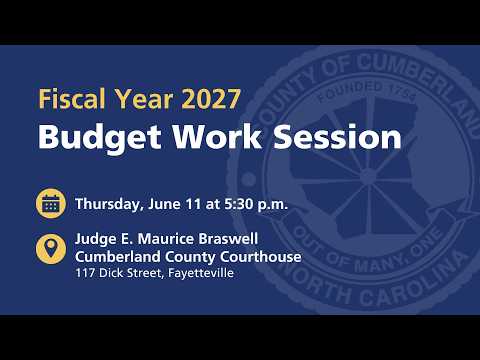
Cumberland County held a budget work session on June 11 to consider whether to use county fund balance to preserve vacant positions in the Department of Social Services (DSS), which Director Brenda Jackson said are critical to child- and adult-protective work.
Jackson told the Board the department is operating under sustained staffing strain after post-COVID vacancies and Medicaid expansion: "We're hanging on by a wing and a prayer," she said, describing social workers carrying caseloads well above standards and widespread overtime. She said many open slots are income-maintenance caseworker positions required to administer Medicaid and SNAP, and warned that failing to staff them could increase county payment-error liabilities.
The issue has budget and timing complexity. Assistant County Manager Bradley said a recent state administrative change referred to in the meeting as "HR1" will increase Cumberland's share of certain costs, with an effective county impact of $2,241,954 beginning Oct. 1, 2026 and an annualized effect of $2,989,272 thereafter. Assistant County Manager Deborah Shaw estimated funding the 41 currently unfunded vacant positions would cost about $2.7 million under the current COLA assumptions.
Vice Chairwoman Jones pressed for immediate action, saying the county has resources to avoid cutting services: "If you have money to use to save lives, that's what I'm for," she told colleagues, and added she would not support actions that she judged to create risk to children and vulnerable adults. County staff said the county's uncommitted fund balance is roughly $8 million after prior commitments, but cautioned that drawing on fund balance to cover recurring personnel costs could affect credit ratings and leave the county short for future recurring needs.
Jackson presented two reconsideration plans the board asked for: an earlier plan tied to reducing 61 abolished positions (about $4.2 million in vacant salary savings) and a revised alternative that she said would generate $3.9 million by abolishing 31 positions, freezing 22 vacancies rather than permanently abolishing them, and applying additional targeted reductions. She told the board the department has already offered $3.9 million in reductions and asked commissioners to consider restoring vacant funded positions where feasible.
Commissioners asked detailed questions about recruitment and retention strategies (internships, partnerships with local universities, recruitment blitzes), and about the limits department heads face in negotiating salaries or reinvesting lapse (unspent) salary dollars. Jackson said compensation competitiveness is the primary barrier to retention and that departmental discretion over salaries is limited.
No final vote was taken on restoring positions. Instead the board directed county staff and DSS to return with modeled scenarios: what it would look like to restore the 61 positions as vacant and funded while keeping the 41 positions frozen/held, and to identify the federal/state cost-sharing for those positions so fund-balance use could be offset. The board scheduled follow-up budget sessions (June 18 and June 22) and flagged September for reviewing fiscal-year results and a case-load study.
The session began with a routine agenda approval motion moved by Commissioner Sherman Jones and adjourned after the budget discussion; commissioners emphasized the need to weigh near-term service risks against the long-term consequences of using one-time fund balance for recurring expenses.