Get Full Government Meeting Transcripts, Videos, & Alerts Forever!
Get email alerts on the Public Art Signage topic
No spam. Unsubscribe anytime.
Petoskey commission narrows public‑art sign template, endorses QR codes for extended information
Summary
The Petoskey Public Arts Commission agreed on a lean signage approach with a QR‑code link to richer online content, asked staff for layout mockups and vendor bids, and set content priorities (title, artist, year, medium, donor, city credit).
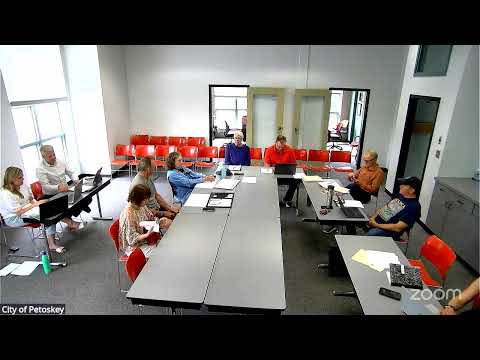
Sheila, who led a slideshow for the Petoskey Public Arts Commission on June 11, outlined options for public‑art signage and recommended a compact, legible template with a QR code linking to extended online information. "Got a slideshow. We'll go over the slideshow," Sheila said as she walked the commission through examples and tradeoffs.
The commission focused first on content hierarchy — what appears on the face of a plaque versus what can be left to a web page. Members converged on a short on‑sign list: title, artist, year (smaller type), medium and donor credit, plus a city credit and a QR code for full text and images. "If we have a QR code, we need less information [on the sign]," Sheila said, arguing the code would keep plaques concise while preserving access to fuller descriptions.
Discussion covered shape, orientation and typography. Commissioners noted legibility and maintenance concerns with ground‑mounted plaques and dense, small‑type designs. Several pointed to the Melbourne example Sheila showed as a clean, readable model and asked for left‑justified, sans‑serif treatments. "I think the year doesn't need to be up and so big," one commissioner said during the exchange on font hierarchy.
Material and durability were key practical considerations. The group discussed stainless steel, bronze, plexiglass and vinyl QR labels and weighed cost, scratch resistance and anti‑graffiti treatments. Kendall, who advised on vendor capabilities, said local fabricators can offer laser‑cut and engraved options and recommended soliciting bids once the commission selects a template.
The commission also treated the Wheelway Art Walk as a special case: a series of approximately 20 panels that may continue to grow and likely will need a different signage or interpretive approach (a single interpretive sign plus per‑panel QR codes). Sheila said she would return with several mockups (portrait and landscape) that vary font weight, QR placement and donor/logo layouts for the commission to refine before issuing bids.
Next steps: staff will produce sample layouts and estimated costs by material so the commission can finalize a template and move to vendor outreach. The commission did not adopt a final RFP or material choice at the meeting; it asked Sheila to bring mockups to a future meeting for decision and bid solicitation.