Get Full Government Meeting Transcripts, Videos, & Alerts Forever!
Get email alerts on the State Board And Graduation topic
No spam. Unsubscribe anytime.
State Board defends narrower standards and a 'profile of a graduate' to emphasize application and transfer
Summary
The State Board of Education told the committee it reduced the number of content standards substantially to prioritize 'guaranteed and viable' instruction, and it is advancing graduation standards and a 'profile of a graduate' focused on applied, transferable competencies.
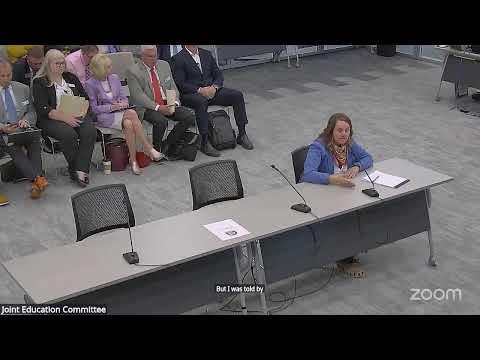
The State Board of Education told the Joint Education Committee on June 1 that its recent work centered on narrowing content standards, prioritizing what districts should be able to teach consistently, and adding graduation standards that emphasize students' ability to apply and transfer knowledge.
Board Chair Mark Mathn said the board reduced the volume of standards to make a set of priorities that educators can deliver in the time available. "We said, 'Let’s just start with the priority standards and let’s see if we need to add from there,'" Mathn said.
The board described three linked elements of the state system: content standards, performance standards (how good is good enough), and the newer graduation standards. Mathn and state board staff explained they conducted extensive listening sessions with educators, businesses and community members when shaping the graduation profile, and that one objective is to ensure students can apply learning in real‑world settings (job shadowing, CTE, community projects).
The board also acknowledged a reporting mismatch: federal graduation measures do not count some state certificates (certificate of completion) as a diploma and thus do not improve federal four‑year graduation rates. Board members said they plan a phased approach to accountability changes, first with internal rule adjustments and then, if needed, legislation to align state measures with the profile of a graduate.
What’s next: The board signaled it will pursue a mix of internal rule changes and recommendations for legislative changes in a later phase to better reflect the state’s graduation expectations and to account for special populations.
Source material: State Board testimony to the Joint Education Committee (June 1, 2026).