Get Full Government Meeting Transcripts, Videos, & Alerts Forever!
Get email alerts on the State Education Governance topic
No spam. Unsubscribe anytime.
LSO outlines century of Wyoming education law; agencies, licensure and standards spotlighted
Summary
The Legislative Service Office presented a memo tracing the statutory development of Wyoming’s education system and multiple agency leaders described current roles—state superintendent, state board, Department of Education, PTSB and the state charter authorizer—emphasizing implementation, licensure volume and safeguards on standards.
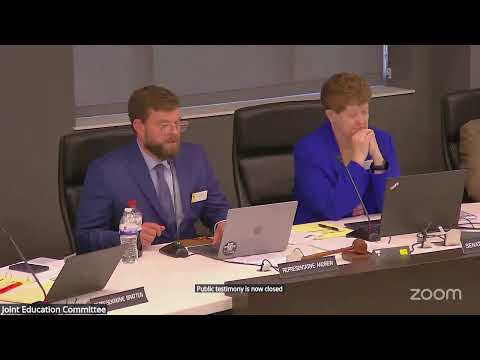
The Select Committee heard a Legislative Service Office memorandum and agency presentations Wednesday that summarized how Wyoming’s public-education duties are distributed among several bodies and how that division affects day-to-day implementation. Ashley Phillips, legislative editor at the Legislative Service Office, told the committee the memo, “History of State Education Agency’s Statutory Duties and Powers,” traces the system from early statutes to more recent additions and federal and court-driven changes.
“The state superintendent is entrusted with the general oversight of the schools,” Phillips said while describing the statutory framework that divides policy-making and administrative tasks among multiple agencies. She noted the state superintendent, the state board of education, the Department of Education, the Professional Teaching Standards Board (PTSB) and the Wyoming Charter School Authorizing Board now share duties first laid out in statute decades ago.
Dicky Shainer of the Department of Education described the department as “a collaborator and a connector,” responsible for implementing policy set by the state board and legislature and operating the systems that carry out rules and accountability. Shainer said the charter-authorizing board is “half appointed by the state superintendent, half appointed by the governor,” and that several state-authorized charters are open or pending approval.
Brendan Okconor, executive director of the Professional Teaching Standards Board, briefed the committee on teacher licensing and oversight. He said the board operates with a small staff—about eight people—processes roughly 5,000 licensing applications a year and manages about 24,000 active licenses. Okconor credited a new online licensing system with cutting processing times to roughly 20 days and described an annual average of about 50 disciplinary matters, most of which are dismissed or resolved short of revocation.
Representatives of the state board of education said the board’s main policy duties center on standards, assessment, accountability and accreditation, and they emphasized the interdependence of those functions. Diana Clap said the board has added a curriculum directors advisory committee to guard against the past accumulation of excessive or duplicative standards and to assess whether proposed standards are “guaranteed” and implementable across districts.
Committee members asked a series of clarifying questions about historical decisions that moved certification responsibilities out of the department and about whether the state’s multiple entities convene jointly. Agency witnesses described past cross‑agency summits and informal coordination but said no standing statewide summit currently brings all parties together on a regular basis.
The committee took the testimony as background for deliberations it deferred until the next day.