Get Full Government Meeting Transcripts, Videos, & Alerts Forever!
Get email alerts on the Budget topic
No spam. Unsubscribe anytime.
House rejects several budget add‑backs, adopts targeted changes including limits on state funds for athlete pay
Summary
The House debated dozens of amendments to House Bill 1 in a marathon third‑reading session, rejecting proposed restorations for invasive‑grass programs, rural health add‑backs and summer child food supplements while adopting changes to protect Game & Fish authority, add narrow transportation investments and prohibit use of general fund dollars to pay student‑athlete compensation. Votes were frequently close and several amendments were divided for separate consideration.
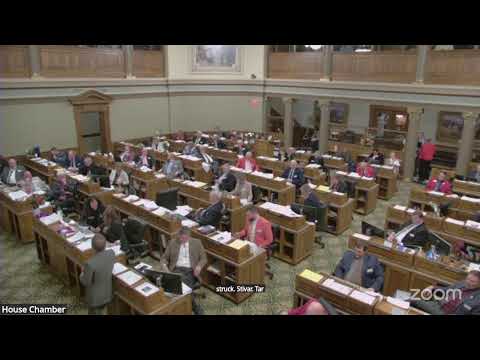
The state House completed a lengthy third‑reading of the general‑fund budget bill, voting on more than three dozen amendments that touched agriculture, transportation, higher education and human services.
Lawmakers rejected a motion by Representative Connolly to add $1 million to a special natural‑resources account in the Department of Agriculture to help weed‑and‑pest districts fight invasive annual grasses. Connolly argued the grasses lower carrying capacity for ranches and raise reseeding and wildfire costs and noted chemical prices ("$1,160 a gallon") as an example of mounting district expenses. The amendment failed on a roll call (14 yes, 44 no, one conflict, three excused).
The chamber adopted a number of narrower technical changes. Representative Byron’s amendment to condition an allocation on Game and Fish Commission approval — which he said "preserves authority over funds for predator control" and prevents diversion that could endanger Pittman‑Robertson federal aid — passed on a division vote, 31–27. Separately the House approved a late amendment that bars use of state general‑fund appropriations to pay student‑athlete compensation (name/image/likeness) so long as those payments come from non‑general‑fund sources, a measure backers said protects the general fund and keeps NIL arrangements in the private/revenue side of university budgets.
On the courts and counsel side, an amendment to restore funding for an additional attorney in the Attorney General’s natural resources division received significant floor debate; proponents said the state faces growing federal litigation on methane, endangered species and coal leasing that will require more legal capacity. The House did not adopt that restoration in its final tally.
A separate and heavily debated amendment proposed using a portion of the Permanent Mineral Trust Fund portfolio for a $100 million public‑purpose loan to the Department of Transportation to address high‑priority highway safety projects. Supporters called it an innovative way to invest in state infrastructure without raising new taxes; opponents urged study and committee review. That amendment narrowly passed after a voice/division and later a counted division (31–29 in recorded division).
Health and human services items were a recurring battleground. Multiple amendments sought to restore or reallocate funding for maternal health, behavioral health, Medicaid provider rebasing and community‑choice waiver capacity for home‑based care. Floor supporters argued those add‑backs were required to preserve rural hospitals and keep people out of more expensive institutional care; opponents raised concerns about long‑term growth in entitlement spending and urged systemic reform. Most of those amendments failed on recorded votes.
Other adopted actions included single‑item approvals such as an amendment to allow a banking division to add positions paid from special funds rather than the general fund. The House also approved a shift inside the developmental‑disability budget (a JAC‑sourced reallocation) to raise provider rates and ease the workforce shortage so providers can serve clients on a waitlist.
Votes were often close; multiple amendments were withdrawn, divided for separate consideration or debated over multiple rounds. Floor leaders set a tight schedule for follow‑up work and signaled the House would reconvene the next morning to resume action on remaining items.
What’s next: the budget now proceeds with the adopted amendments to conference. Several failed proposals may reappear in conference committee or as stand‑alone bills; lawmakers flagged transportation, community‑college funding and several health items as subjects for follow‑up work in the interim.