Get Full Government Meeting Transcripts, Videos, & Alerts Forever!
Get email alerts on the Budget topic
No spam. Unsubscribe anytime.
Bassett Unified presents a near‑balanced 2026–27 budget; board cautioned on state 'settle up' and labor costs
Summary
Chief Business Officer presented the proposed 2026–27 budget showing $57.7M in combined revenues and a roughly $141,000 unrestricted operating deficit; trustees were advised to be cautious about one‑time COLA components, pending negotiated labor agreements and a state 'settle up' that could affect long‑term revenue.
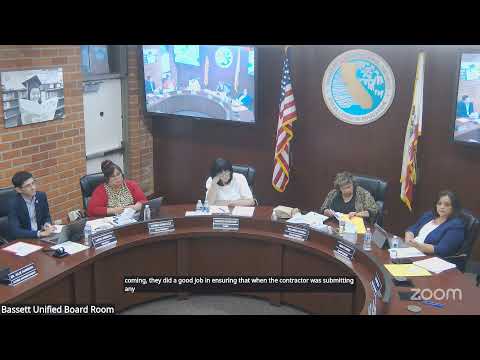
Bassett Unified’s chief business officer presented the district’s proposed 2026–27 budget to trustees on June 9, highlighting revenue and expenditure assumptions, multi‑year projections and required reserve levels.
Key points from the presentation: projected combined district revenues of about $57.7 million and expenditures of roughly $57.9 million; an unrestricted projection of $38.3 million in revenues and $38.5 million in expenditures (an operating gap near $141,000); a combined ending fund balance of about $33.5 million (which includes restricted funds) and an unrestricted ending balance reported at $20.5 million. The district maintains a required 3% reserve and an additional board‑set 7% reserve (together approximately $5.8 million).
The CBO explained how LCFF is composed (personal income tax, corporate tax and sales tax), discussed the governor’s proposed COLA and a discretionary one‑time COLA element (1.44%) intended for temporary mandates, and cautioned that a state “settle up” (borrowing/deferral mechanics) and pending negotiated agreements with bargaining units could reduce the district’s available unrestricted balance. Trustees asked clarifying questions about enrollment and ADA assumptions used in projections and whether tentative agreements will be reflected in the budget.
Nut graf: While the proposed budget is close to balanced on paper, the presentation emphasized fiscal caution: one‑time state funds, the timing of labor negotiations, and enrollment trends could materially affect the district’s available resources for 2026–27.
Ending: Staff said the proposed budget will return to the board for adoption on June 23 with the multi‑year projection; trustees requested continued monitoring of enrollment, labor negotiations and state actions affecting Prop 98 funding.