Get Full Government Meeting Transcripts, Videos, & Alerts Forever!
Get email alerts on the Land Use topic
No spam. Unsubscribe anytime.
Boone County commissioners debate livestock setback language as UDO moves forward
Summary
County staff and a Sightland consultant presented a draft Unified Development Ordinance; public commenters and the Farm Bureau urged matching state livestock siting rules and preserving reverse buffer protections for existing farms. The board asked staff to vet the statute with the state's attorney and return with proposed edits.
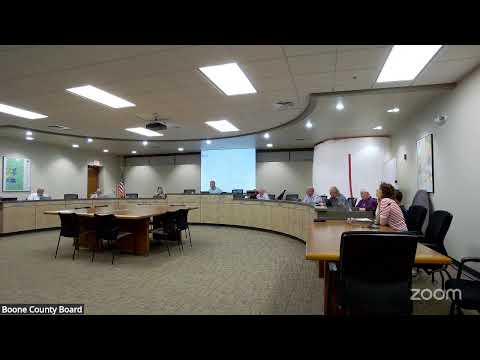
Boone County commissioners and staff spent much of the June 11 finance committee meeting debating how the draft Unified Development Ordinance should treat setbacks for livestock operations.
Consultant Jake of Sightland Consultants presented the county's proposed UDO, saying it is designed to streamline zoning and subdivision rules, make the code easier to use and keep the provisions that “work” while removing confusing language. He told the committee the UDO is structured so the administrative rules (articles 1–5) direct how an application flows to the Zoning Board of Appeals, the planning commission and, ultimately, the county board.
Public comment and several commissioners focused on a contested passage in the draft that would create setbacks described in the draft as 500 feet from lot lines and 1,320 feet from non‑agricultural uses for certain livestock management facilities. “We're concerned with the added language in the current draft on page 86…being a minimum of 500 ft from any lot line and 1,320 ft from any non‑agricultural use,” said John Mitchell during the public‑comment period.
Farm Bureau representatives and several commissioners urged the county to align the UDO with the state Livestock Management Facilities Act (LMFA), which measures certain setbacks from occupied dwellings rather than from property lines. A Farm Bureau representative told the committee the LMFA includes notice, waiver and variance mechanisms and said a county rule using lot lines could unintentionally block smaller farms from expanding.
County staff and commissioners discussed practical implications. Staff noted the LMFA provides the state review pathway for large facilities and that counties cannot adopt local rules that effectively prohibit operations that meet state standards. Commissioners raised fairness concerns about using a neighbor’s lot line as the basis for another person's setback and the cost and difficulty of verifying lot lines for every permit application.
Several commissioners suggested solutions short of immediate code language changes: require applicants for subdivisions or planned developments to check the Department of Agriculture list of existing facilities; add self‑reporting or permit triggers when an operator proposes expansion; and craft a separate “reverse setback” provision to protect existing livestock operations from nearby residential development. Staff agreed to check the LMFA with the state's attorney and to return with suggested edits the following week.
The committee did not adopt final language at the meeting. Instead, members agreed to take the following steps: legal review of the state statute, draft clearer reverse‑setback language for planned developments and consider application checklist changes requiring applicants to identify nearby livestock facilities.
The UDO overhaul — including the zoning map and many other provisions discussed at the meeting — will return to the board for further review and formal action at an upcoming county board meeting.