Get Full Government Meeting Transcripts, Videos, & Alerts Forever!
Get email alerts on the Decarbonizing Peak topic
No spam. Unsubscribe anytime.
Advisory board affirms modeling approach to guide peaker-plant replacements
Summary
The Energy Transformation Advisory Board voted to advance the Decarbonizing the Peak work group's modeling into a policy phase after reviewing near- and long-term scenarios showing storage and load management can replace some peaker operations but that longer-duration resources will be needed by 2040.
The Energy Transformation Advisory Board on a near-unanimous vote moved the Decarbonizing the Peak working group into a policy-development phase after reviewing modeling that maps how alternatives could replace existing peaker plants.
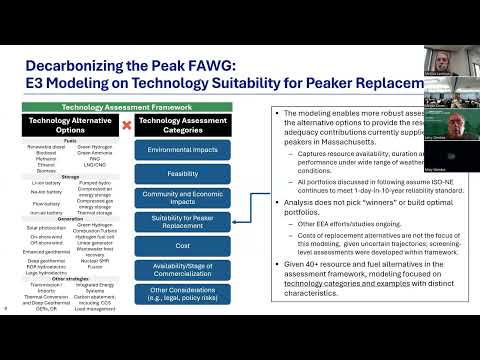
The board’s vote affirms the group’s technical approach and asks it to develop policy-focused recommendations in Phase Three. Toby (co-facilitator) introduced the item and Liz, the working-group presenter, summarized a loss-of-load-probability modeling exercise designed to test how alternatives perform during extreme, grid‑constrained conditions. Liz said the team “ran a loss of load probability model to look at how different alternatives to peaker plants perform in supporting the system during the most grid constrained extreme conditions.”
Why it matters: the modeling shows that in 2030 short-duration storage, active load management and combinations of renewables and storage can replace a portion of peaker operations during evening peaks. By 2040, however, higher peak demand and extended low-renewable periods increase the need for longer-duration energy resources or additional firm capacity to preserve resource adequacy.
Key findings presented by Liz included that removing roughly 1.8 gigawatts of older peaker capacity produces a resource gap on the order of the same scale (the presentation noted an illustrative need of about 1.66 GW of “perfect capacity”), and that scenarios adding roughly 2 GW of storage reduced a substantial portion of that gap in modeled near-term cases. Liz cautioned the group that the work is directional and not a definitive system plan: the modeling does not attempt a least-cost portfolio but focuses on what physical attributes replacement resources must provide.
Board members pressed on sensitivities and assumptions. Jose asked how the model handles multi‑day low‑renewable weather patterns and the presenter said the team ran Monte Carlo draws using about 40 years of weather history and simulated thousands of sequences to capture extreme conditions. Members also asked for cost comparisons (dollars per ton of avoided CO2) and for closer alignment with ISO New England and other modeling efforts; Liz and other work-group members said cost and policy trade-offs will be emphasized in Phase Three.
The motion to affirm the group’s assessment and to allow work to proceed to Phase Three passed; meeting notes show one opposition and two abstentions in the room, with online participants reporting no opposition.
Next steps: the working group will incorporate today’s technical questions and stakeholder requests (cost metrics, sensitivity analyses, and community impacts) into Phase Three and return to the board with policy recommendations and implementation options.