Get Full Government Meeting Transcripts, Videos, & Alerts Forever!
Get email alerts on the National Guard Readiness topic
No spam. Unsubscribe anytime.
Wyoming Guard briefs committee on overseas operations, wildfire readiness and shifts to firefighter benefits; Tricare mental‑health fix tabled
Summary
Major General Greg Porter told the joint Transportation, Highways & Military Affairs Committee that Wyoming Guard units are contributing to overseas operations and preparing for an above‑average wildfire season; the committee tabled a Tricare mental‑health reimbursement proposal for more data and asked LSO to draft a bill to equalize death benefits for National Guard firefighters.
Major General Greg Porter, the state’s Adjutant General, told the Joint Transportation, Highways & Military Affairs Committee on May 5 that Wyoming National Guard personnel are participating in overseas operations and that the state must prepare for an above‑average wildfire season.
Porter said National Guard formations are contributing to what he described as “Epic Fury” operations in the Strait of Hormuz and that Wyoming Guard air and ground elements are involved in deployments and targeting support. Porter also warned that 2026 drought and snowpack readings (drought at roughly 96 percent and snowpack at about 79 percent in his briefing) signal a likely robust wildfire season and earlier use of the Modular Airborne Firefighting System and other assets.
The update covered multiple readiness topics: planned fall deployments for Air Guard aircraft and KC‑130 support, Army Guard unit returns and reset of launchers, a planned C battery (rocket battalion) recruitment and stand‑up in 2027–28, and small wildland firefighting teams arriving next fall. Porter described a 200‑member National Guard Reaction Force trained under Title 32 orders and said the state’s focus for that unit is critical‑infrastructure and disaster response rather than civil‑disturbance missions.
Committee members pressed Porter on several personnel and benefit issues. Porter said the department has not yet completed a provider survey to prove whether Tricare reimbursement rates are blocking mental‑health providers from accepting Guard beneficiaries; he recommended more outreach to the Department of Health and federal partners and said the department will return to the committee in August if data show a problem. Representative Larson urged the department to gather specific usage and denial data and to involve state public‑health officials in the outreach.
On pay and benefit disparities for state‑active‑duty service members, Porter told the committee that workers’ compensation is the principal remedy for mission‑related injuries while on state duty but that it typically provides less compensation than federal retirement or disability programs. He said full parity with federal benefits would be cost‑prohibitive and recommended continued reliance on workers’ compensation and selective reimbursement programs the department already uses.
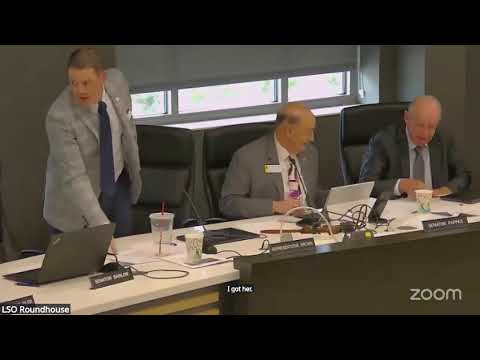
The committee moved and approved a separate action on National Guard firefighter death benefits. Porter proposed folding the roughly 40 Guard firefighters into the state’s ‘Plan B’ retirement death‑benefit structure used for career firefighters so that similar line‑of‑duty deaths would result in equivalent retirement‑plan payments. Representative Landon moved, Senator Barlo seconded the motion directing Legislative Service Office (LSO) to draft legislation on the change, and the committee voted in favor.
Porter framed the larger budget concern in defense appropriation trends: while the federal president’s $1.7 trillion defense topline includes large procurement investments, he said operations and maintenance and full‑time manning accounts have not proportionally increased, producing a widening gap between mission demands and full‑time resources at the state National Guard level. He told lawmakers that if enacted as proposed, the presidential budget could reduce some operations funding and that the Guard must continue to identify local priorities for readiness and personnel.
The committee took no immediate action on Tricare reimbursement changes; members asked the department to pursue provider surveys and a more detailed data set before returning a bill draft. The committee did direct LSO to draft legislation to equalize firefighter death benefits and asked the department to provide requested clarifying information on the composition and benefits of the Guard firefighter cohort before final bill language is prepared.