Get Full Government Meeting Transcripts, Videos, & Alerts Forever!
Get email alerts on the Center Lane Management topic
No spam. Unsubscribe anytime.
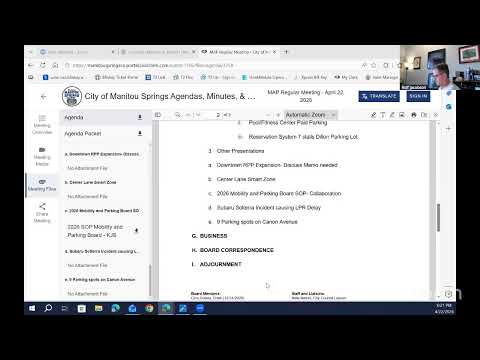
Manitou Springs staff introduce 'smart zone' proposal to modernize center lane loading
Summary
Staff proposed a QR/camera-based "smart zone" to modernize Manitou Springs' center lane loading rules—preserving the current 15-minute active-loading standard while moving from hand tags to registration and plate recognition. Board members raised concerns about large deliveries, commercial exemptions and local fit; no vote was held.
James, a MAP staff member, introduced a concept to modernize the city’s center lane on Manitou Avenue by registering short-term loading users through QR codes or automatic license‑plate recognition.
"If they are there for less than the 15 minutes, there would be no charge," James said, describing a system that would preserve the ordinance’s short-term active-loading purpose while replacing hand tags with digital registration or camera detection.
Felipe, also on staff, said the proposal’s goals are to "improve access for deliveries and pickup activity, support turnover, reduce misuse of the lane and improve clarity for businesses, staff and the public." Staff said the approach could be implemented in phases, beginning with low-cost QR-code registration and moving to camera-based plate recognition for enforcement if needed.
Board members voiced several operational concerns. Joy Porter questioned whether a strict 15‑minute limit would be realistic for larger trucks that need extra time to unload, saying, "sometimes with traffic in the summer you can't unload the larger trucks in 15 minutes." Several members urged a flexible, phased trial with outreach to businesses and suppliers before any fines or automated enforcement are introduced.
Board member Ralph Jacobson and others suggested staff consult other mountain towns with similar curb constraints. Felipe noted lessons from longer pilots in cities such as Pittsburgh and Philadelphia while acknowledging Manitou Springs’ unique street geometry.
Members also pressed staff on a provision of the current ordinance that exempts commercial delivery vehicles from permit requirements; Joy observed that exemption could be misused and asked staff to consider how to prevent vehicles from using a commercial designation to occupy center-lane space long-term.
Staff emphasized this was an information and direction-seeking item, not a request for formal endorsement. James said the next steps include additional business engagement, a beta trial period, data collection and potential ordinance refinements; no ordinance change or vote occurred at the meeting.
The board asked staff to return with pilot parameters, quantification of current noncompliance, outreach plans and options for accommodating larger commercial deliveries during busy summer periods.