Get Full Government Meeting Transcripts, Videos, & Alerts Forever!
Get email alerts on the Land Use topic
No spam. Unsubscribe anytime.
Zoning board presses applicant on ADA access, parking and landscaping; hearing on 166 Commonwealth Ave continued to July 9
Summary
Applicants for a renovated gas station and retail 'country store' at 166 Commonwealth Ave described new double-wall fuel tanks, a new canopy, stormwater controls, EV chargers and landscaping. Board members pressed the team on ADA access, curb-cut routing, parking counts and plant choice; the application was continued to July 9 for redesign and follow-up.
The Concord Zoning Board of Appeals on June 11 heard a presentation for a proposed renovation of the former gas station at 166 Commonwealth Ave, a prominent West Concord corner, but continued the application for further design revisions.
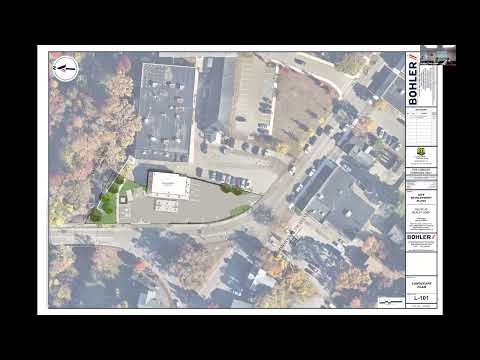
Jonathan Silverstein, counsel for the applicant, told the board the project would partially demolish the existing structure, remove single-wall underground storage tanks and install state-of-the-art double-wall tanks, replace the canopy, add stormwater best-management practices, reduce impervious cover and install electric vehicle charging. He said the interior retail would be an Imperial Country Store format focused on local goods rather than a typical convenience store.
Board members and staff praised the project’s intent to clean up the site but pressed the applicants on multiple operational and safety details. Members asked for clearer plans showing pedestrian access from the new crosswalk and the riverwalk connection, and insisted on compliant curb ramps for wheelchair and stroller access. A board member warned the current design creates a trip hazard where an island and curbing could cause falls and described the existing island detail as “a lawsuit waiting to happen.”
Questions also focused on parking. The applicant said the site would provide 11 spaces (including two EV spaces and an accessible stall), which exceeds the nine-space bylaw minimum, but board members and a public commenter noted EV stalls can functionally reduce available customer parking if EV vehicles are not present. The applicant said the EV stalls are a bylaw requirement and that the spaces adjacent to chargers are intended for charging activity rather than long-term parking.
Members raised concerns about the proposed rip-rap used to handle grade and erosion at the property edge and questioned whether a short retaining wall and a re-angled parking layout could eliminate rip-rap while improving the aesthetic. One member criticized the proposed planting palette (calling the choice of redbud trees poor for small asphalt islands) and asked the applicant to propose longer-lived, native, drought-tolerant species consistent with the Natural Resources Commission list.
Engineering and conservation review were already in progress: the applicants said the project has been peer-reviewed, coordinated with DPW and the Conservation Commission, and that planning had recommended the project. The applicant committed to replace the single-wall tanks, add stormwater treatment, improve sidewalks and lighting (all fixtures chosen at a 2700K color temperature to meet board guidance).
West Concord resident Christina Stson urged the designers to add a bike rack and questioned whether two EV stalls are necessary given weekday lunchtime demand from nearby businesses and playground users. The applicant said they will consider adding short-term bike parking near the public sidewalk connection.
Outcome: The board voted to continue the application without final action, scheduling the next hearing for July 9 at 7:25 p.m. The board asked the applicant to return with revised plans addressing ADA routing/curb cuts, the parking layout and circulation to reduce the need for rip-rap, planting substitutions and clearer night‑time lighting details.
What’s next: Applicants will revise the site plan to address the board’s ADA, circulation and landscaping concerns and will appear for the continued hearing July 9. The board also noted continued coordination with DPW, Conservation/NRC and engineering peer reviewers will be required.