Get Full Government Meeting Transcripts, Videos, & Alerts Forever!
Get email alerts on the Asset Mapping topic
No spam. Unsubscribe anytime.
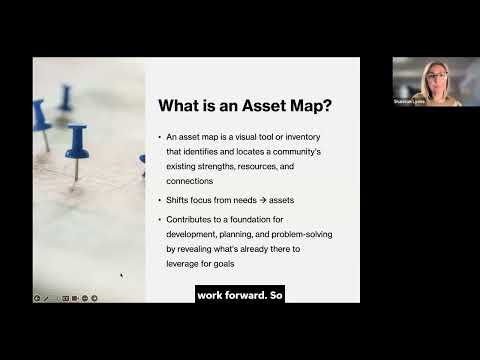
Shannon Lyons outlines asset-mapping framework to help communities plan and apply for grants
Summary
At a Rutgers-hosted Inclusive Healthy Communities webinar, Shannon Lyons defined community assets, explained two asset types and six flexible categories, and described how mapping can support planning, grant applications and inclusion for older adults and people with disabilities.
Shannon Lyons, a presenter with more than a decade of experience in age-friendly community work, told webinar attendees that asset mapping shifts attention from community deficits to existing resources that can support planning and grant proposals. "They're the things that are important to members of your community," Lyons said, listing people, services, physical places and social connections as typical assets.
Rebecca Martin, project manager for the Inclusive Healthy Communities grant program administrative team at Rutgers (Bloustein School of Planning and Public Policy), opened the session and thanked the New Jersey Division of Disability Services for supporting the webinar. She said the asset-mapping approach is useful both for community organizers and for preparing stronger grant applications.
Lyons described two broad asset types — tangible assets such as parks or transit stops, and intangible assets such as skills, talents and social ties — and then presented six common categories used by practitioners: individuals, associations, physical assets, institutional assets, local economy and culture/stories. "Those are just generally the ways people feel like it's most beneficial to define assets," she said, adding the categories are a starting point rather than a rigid rule.
Lyons urged organizers to surface local "connectors" — trusted residents who may not hold formal roles but who link people and services across neighborhoods. She said connectors are valuable when mapping community networks and when organizing participatory mapping events.
The presentation included examples of simple formats (paper maps or lists), more visual displays (charts or color‑coded maps) and master spreadsheets that record contact information and category tabs to support collaboration and ongoing updates. Lyons emphasized the importance of maintaining an asset map over time: organizations should decide who will keep the map current so contact information and personnel changes do not erode its usefulness.
The webinar closed with Lyons encouraging participants to integrate asset mapping into work plans and grant proposals so the activity is funded and sustained. Rebecca Martin said slides and links to the tools discussed would be shared with attendees.